

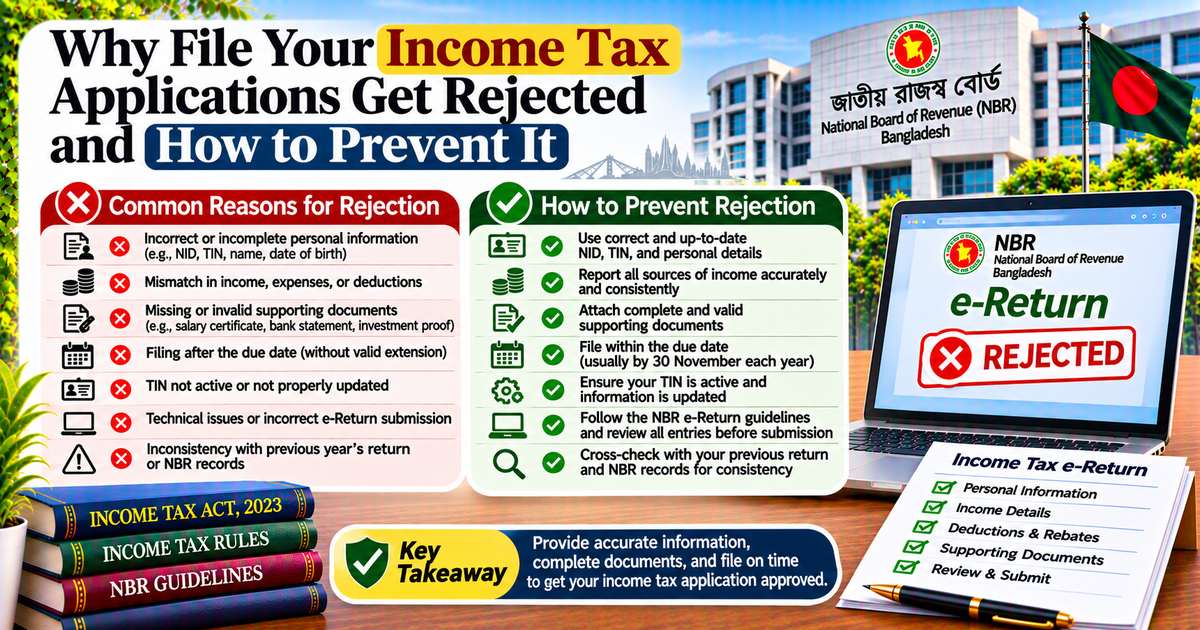
Why Income Tax Filing Applications Get Rejected in Bangladesh and How to Prevent It
Introduction
Filing an income tax return or submitting a tax-related application in Bangladesh does not always guarantee immediate acceptance or approval. An application may remain pending, require correction, or be rejected because of inconsistent taxpayer information, incorrect financial disclosures, unsupported tax claims or procedural errors.
For individuals and businesses, these issues can create delays in obtaining proof of return submission, tax certificates or other tax-related services. In some cases, inaccurate declarations may also expose taxpayers to further scrutiny.
Understanding the common reasons behind rejection is therefore essential for maintaining tax compliance and avoiding unnecessary complications.
This article explains why income tax filing applications and related requests may be rejected in Bangladesh and outlines practical steps to reduce that risk.
1. Incorrect or Inconsistent Taxpayer Information
One of the most common sources of difficulty is a mismatch between the taxpayer's information and the information recorded in the National Board of Revenue (NBR) system.
Examples include:
Incorrect name or date of birth.
Wrong gender information in the TIN profile.
Incorrect Taxpayer Identification Number (TIN).
Differences between National Identity Card (NID) and TIN records.
Outdated mobile number or contact information.
Incorrect assessment-year or income-year selection.
These discrepancies can prevent successful registration, create calculation errors or delay the processing of a request.
How to prevent it: Verify the TIN profile and personal information before starting the return. If NID information has been corrected, check whether the TIN record requires revalidation and use the e-Return profile's synchronisation option where applicable.
2. Incorrect Income Classification
Bangladesh's income tax framework recognises different heads of income, including employment, rent, agriculture, business, capital gains, financial assets and other sources.
Problems can arise when taxpayers:
Report professional income under an inappropriate category.
Omit income from a second employer.
Fail to disclose rental or business income.
Report investment income incorrectly.
Enter withholding-tax information without reporting the corresponding income.
For example, a professional receiving consultancy fees may need to report the income under the appropriate business or professional income category rather than incorrectly treating it as employment income.
How to prevent it: Review every income source and classify it under the appropriate head. Reconcile salary certificates, bank statements, withholding-tax certificates and business records before submission.
3. Mismatch Between Declared Income and Tax Deducted at Source
Taxpayers may claim tax deducted at source (TDS) or advance income tax (AIT) as a credit. However, a discrepancy between the income declared and the tax credit claimed can trigger validation problems.
For example, a taxpayer may report bank interest in the income section but claim a different amount of bank TDS in the tax-payment section.
The NBR's official income tax FAQ specifically identifies inconsistencies between declared income and bank TDS claims as a source of e-Return errors.
How to prevent it:
Collect relevant bank statements and tax deduction certificates.
Verify the income amount and tax deducted.
Ensure the income section and Tax & Payment section contain consistent information.
Use the e-Return Ledger's synchronisation facility where applicable.
Retain supporting documents for verification.
4. Incorrect or Unsupported Advance Tax Claims
A taxpayer may have paid advance income tax or other eligible taxes but fail to provide the correct payment reference.
Common issues include:
Incorrect challan number.
Wrong transaction identification number.
Incorrect payment date.
Claiming tax paid in a different income year.
Entering an amount that does not match the payment record.
For certain advance tax claims, the NBR system requires specific payment references or transaction identifiers.
How to prevent it: Verify the payment details against the original bank receipt, challan or payment confirmation. Enter the correct transaction information in the relevant e-Return Ledger section.
5. Incomplete or Incorrect Asset and Liability Information
Asset and liability disclosures are an important part of individual tax compliance where applicable.
Problems may occur when taxpayers:
Omit bank balances or investments.
Report property values inconsistently.
Fail to disclose loans or other liabilities.
Include assets that have already been sold or transferred.
Report unexplained changes in net wealth.
Provide figures that conflict with previous returns.
An unexplained difference between current and previous financial disclosures may invite questions or further verification.
How to prevent it: Prepare an asset and liability statement before filing. Reconcile property, bank balances, investments, loans and other relevant financial information with supporting records. Carry forward previous-year information only after checking whether it remains accurate.
6. Failure to Follow the Correct Application Procedure
Not every tax-related service follows the same procedure. A return submission, tax certificate request, correction request and application for an administrative approval may involve different requirements.
For example, the NBR e-Return user manual explains that taxpayers can monitor the status of certain certificate requests and that a rejected request may display the reason for rejection.
Submitting a request through the wrong channel or failing to provide the required information can delay processing.
How to prevent it: Identify the exact service required, follow the relevant NBR instructions and review the request status after submission. If the system provides a rejection reason, address that specific issue rather than submitting an identical request again.
7. Incorrect Tax Payment Information
A payment may have been initiated, but the e-Return system may not immediately reflect it.
This can happen because of:
Incorrect payment references.
Payment processing delays.
A mismatch between the payment amount and the tax payable.
An unsuccessful or incomplete transaction.
A temporary system issue.
How to prevent it: Keep the payment receipt and transaction reference. Recheck the Tax & Payment section after logging in again. If money has been deducted but the tax liability still appears unpaid, contact the NBR support channel rather than paying again without checking the transaction.
8. Filing Under the Wrong Assessment Year
The income year and assessment year are not interchangeable.
A taxpayer who selects the wrong assessment year may enter otherwise accurate financial information in the wrong filing period. This can cause incorrect tax calculations and inconsistent records.
How to prevent it: Confirm the relevant income year and assessment year before entering financial information. Check the applicable NBR instructions for the relevant tax year.
9. Failure to Correct Errors After Submission
Some taxpayers assume that saving or preparing an online return is equivalent to successfully submitting it. It is not.
Taxpayers should confirm that the return has been formally submitted and that the system has generated the relevant acknowledgement or proof of submission.
The NBR's current e-Return FAQ states that, subject to applicable conditions, an online return may be revised once within 180 days of submission. Taxpayers should verify the latest requirements before relying on this facility.
How to prevent it: Review the complete return before final submission. After submitting, download and preserve the acknowledgement and relevant records. If an error is discovered, check the current rules on revised returns and seek professional advice where necessary.
10. How Businesses Can Avoid Tax Application Rejection
Companies, partnerships and other business entities should pay particular attention to the accuracy and consistency of their financial and tax records.
Common risk areas include:
Inconsistency between financial statements and tax computations.
Incorrect reporting of turnover, expenses or profit.
Missing supporting documents.
Incorrect withholding-tax information.
Unreconciled bank balances.
Errors in identifying the appropriate taxpayer or authorised representative.
Failure to follow the applicable filing and approval procedure.
Businesses should establish an internal tax review process before submitting returns or other applications.
Practical Checklist Before Submitting an Income Tax Application
Use this checklist before filing or requesting a tax-related service:
Confirm TIN, NID and personal or business information.
Select the correct assessment year and income year.
Verify all income sources and classifications.
Reconcile TDS and AIT claims with supporting records.
Check asset and liability disclosures, where applicable.
Verify challans, payment receipts and transaction references.
Review the tax calculation and payment status.
Follow the correct procedure for the requested service.
Save the submission acknowledgement and supporting documents.
Check the application or request status after submission.
What Should You Do If Your Application Is Rejected?
If an income tax-related application is rejected, take a systematic approach:
Read the rejection reason: Check the portal or official communication for the stated reason.
Identify the affected information: Determine whether the issue concerns identity, income, payment, supporting documents or procedure.
Verify the original records: Compare the submitted information with authentic documents.
Correct the underlying error: Follow the relevant NBR procedure for updating or correcting the information.
Contact the appropriate tax authority: Use the official support channel if the rejection reason is unclear or a technical issue persists.
Seek professional assistance: Obtain advice where the matter involves disputed tax liability, complex income classification or statutory compliance.
Do not repeatedly submit the same incorrect information without understanding the reason for rejection.
How The Justice Corner Can Assist
Tax compliance involves more than completing an online form. The accuracy of financial disclosures, appropriate interpretation of tax rules and proper handling of procedural issues can all affect the outcome.
The Justice Corner provides corporate and finance-related legal support in Bangladesh, including assistance with tax compliance matters, review of tax-related documentation and guidance on regulatory procedures.
For taxpayers facing complicated filing issues, a professional review can help identify inconsistencies and determine the appropriate next steps.
Frequently Asked Questions
1. Can NBR reject an online income tax return?
An online return may encounter validation errors or other processing issues. Certain tax-related requests, such as certificate requests, may also be rejected. The taxpayer should check the system's stated reason and follow the appropriate correction procedure.
2. Why is my bank TDS not matching my declared income?
This may happen when the income reported in the return does not match the income information used to claim the corresponding bank TDS. Reconcile both sections and use the e-Return Ledger's synchronisation facility where applicable.
3. What should I do if my TIN information is incorrect?
Check the TIN system's correction or update facility. Where relevant, update the information and synchronise the e-Return profile with the corrected TIN record.
4. Can I correct an income tax return after submission?
The NBR's current e-Return guidance provides for a revised return once within 180 days, subject to applicable conditions. Confirm the latest rules and eligibility before filing a revision.
5. What if tax has been deducted from my bank account but the e-Return system shows unpaid tax?
Keep the transaction receipt, log in again and check the payment status. If the amount remains unpaid in the system, contact NBR support with the transaction details.
6. Does an application rejection automatically mean that tax has not been paid?
No. A rejection of a certificate or other administrative request does not necessarily establish that a tax payment was unsuccessful. Check the relevant payment records and the status of the specific service.
Conclusion
Income tax application rejection in Bangladesh can result from incorrect taxpayer information, inconsistent income disclosures, unsupported tax credits, payment-reference errors or failure to follow the correct procedure.
Most preventable problems can be reduced through careful preparation, reconciliation of financial records and review of NBR instructions before submission.
Taxpayers should treat every filing as an important compliance exercise—not simply an online form to complete.
Legal Disclaimer: This article provides general information on Bangladesh tax compliance and NBR e-Return procedures. The appropriate treatment of a particular application depends on the facts, applicable law and current NBR instructions. It should not be treated as individual legal or tax advice.