

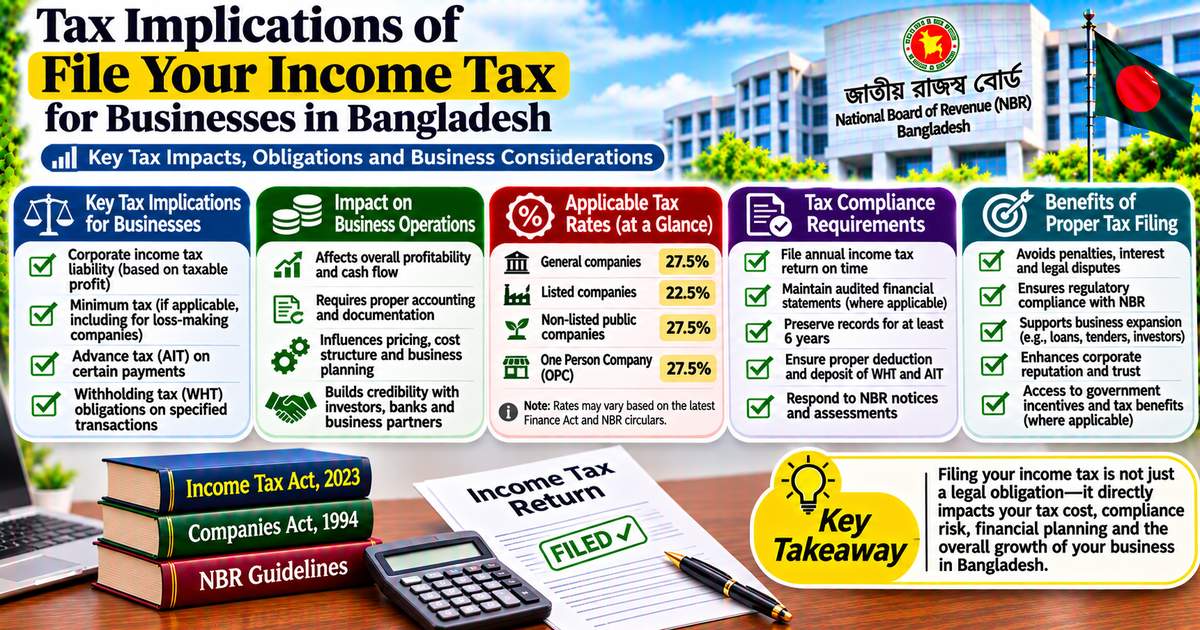
Tax Implications of Filing Your Company's Income Tax Return in Bangladesh Introduction
1. Income Tax Is Calculated on Taxable Income, Not Simply Accounting Profit
One of the most important implications of filing a business income tax return is the determination of taxable income.
A company's accounting profit and taxable income may be different because income tax law prescribes specific rules for recognising income, allowing expenses and calculating deductions.
For example:
Some accounting expenses may not qualify for tax deduction.
Certain expenses may be subject to statutory restrictions.
Tax depreciation may differ from accounting depreciation.
Exempt or specially taxed income may require separate treatment.
Certain income and expenses may require tax-specific adjustments.
A company should therefore prepare a tax computation that reconciles accounting profit with taxable income.
Illustrative example
| Particulars | Amount |
|---|---|
| Accounting profit before tax | Tk 50,00,000 |
| Add: Expenses not allowable for tax | Tk 5,00,000 |
| Less: Additional eligible tax deductions | Tk 2,00,000 |
| Illustrative taxable income | Tk 53,00,000 |
This is a simplified illustration, not a prescribed tax calculation. Actual adjustments depend on the nature of the transactions and applicable law.
2. Corporate Tax Rates Affect the Company's Final Tax Liability
The applicable corporate income tax rate depends on the company's legal and business category and the assessment year.
For assessment years 2026–2027 and 2027–2028, the NBR's published rate table identifies, among other categories:
Other companies: 27.5%.
Certain publicly traded companies: 22.5%, with a 20% rate where the specified bank-transfer condition is satisfied.
Publicly traded banks, insurance companies and finance companies: 37.5%.
Non-publicly traded banks, insurance companies and finance companies: 40%.
These are category-specific rates, not a universal rate for every business. Other categories and special provisions may apply. The eligibility conditions for a reduced rate should be verified before it is claimed. <Cite refs={["turn359248search35"]}/>
A business should confirm its classification, applicable rate and any conditions attached to a tax benefit before finalising its return.
3. Minimum Tax May Affect Businesses Even When Accounting Profit Is Low
A company should not assume that a low accounting profit or business loss automatically means that no income tax is payable.
The Income Tax Act, 2023 contains minimum tax provisions that can apply in specified circumstances. Depending on the taxpayer category and nature of receipts, the calculation may involve gross receipts or tax deducted or collected at source.
The applicable treatment and rates depend on the statutory provisions and the relevant business category. For example, the Act contains provisions dealing with minimum tax on certain gross receipts, including different rates for specified categories. <Cite refs={["turn359248search40","turn359248search34"]}/>
Business implication: A company with substantial turnover but a relatively small accounting profit should review minimum tax exposure before assuming that its tax liability will be based only on its net profit.
4. Business Expenses Can Reduce Taxable Income, Subject to Legal Conditions
Legitimate business expenses can reduce taxable income when they satisfy the applicable tax requirements.
Common expense categories include:
Salaries and employee benefits.
Office rent.
Utility bills.
Marketing and advertising.
Professional and consultancy fees.
Business travel.
Repairs and maintenance.
Eligible interest expenses.
Depreciation and amortisation.
Approved bad debts.
However, recording an expense in the accounting system does not automatically make it deductible.
The Act provides for business deductions and specific conditions for certain expenses. It also addresses special deductions, depreciation, research and development expenses, bad debts and interest expenses. <Cite refs={["turn359248search34"]}/>
A company should maintain invoices, contracts, payment records, payroll information and other evidence to support its deductions.
5. Withholding Tax Compliance Can Create Additional Financial Exposure
Businesses in Bangladesh may have obligations to deduct or collect tax at source when making specified payments.
Depending on the transaction, these may include payments for:
Rent.
Salaries.
Professional services.
Consultancy.
Contractor services.
Commission.
Interest.
Certain supplier payments.
Payments to non-residents.
The company must determine whether withholding tax applies, use the legally applicable rate and deposit the amount within the prescribed period.
A company may also have separate withholding tax return and reporting obligations. Filing its annual income tax return does not automatically fulfil those separate obligations. <Cite refs={["turn359248search42","turn359248search34"]}/>
Failure to comply can create additional tax and penalty exposure. Businesses should reconcile their withholding tax records with payment evidence, certificates and accounting ledgers.
6. Tax Payments and Withholding Credits Affect Cash Flow
Filing a return requires a company to identify its final tax position after considering eligible tax payments and credits.
These may include:
Advance income tax.
Tax deducted at source.
Tax collected at source, where applicable.
Other legally admissible tax credits.
Previous tax adjustments, where permitted.
The company should verify that the claimed credits are supported by appropriate evidence.
If the amount already paid is lower than the final liability, the company may need to pay the remaining amount. If eligible payments exceed the calculated liability, the company should review the applicable adjustment or refund provisions.
This is why tax planning should be connected to cash-flow forecasting rather than being left until the filing deadline.
7. Tax Depreciation and Asset Transactions Affect Business Investment Decisions
A company's purchase, use and disposal of fixed assets can affect its taxable income.
For example, machinery, vehicles, office equipment and other qualifying assets may be eligible for tax depreciation or other statutory allowances, subject to the relevant conditions.
The tax treatment may differ from the depreciation recorded in the company's financial statements.
Businesses should review:
Cost of newly acquired assets.
Date assets were put into use.
Applicable tax depreciation.
Opening written-down values.
Asset disposal proceeds.
Scrapped or written-off assets.
Supporting purchase and sale documents.
Correct asset records help the company calculate taxable income accurately and maintain evidence for future assessment.
8. Losses and Unabsorbed Deductions Require Careful Review
A business that incurs a loss should examine whether the loss can be set off or carried forward under the applicable tax provisions.
The treatment can depend on the category and source of income, the type of loss and statutory restrictions.
A company should not assume that every accounting loss can automatically be deducted from future taxable income.
It should maintain:
Previous tax computations.
Assessment records.
Loss schedules.
Supporting financial statements.
Records of any earlier adjustments.
Evidence of unabsorbed depreciation, where applicable.
Correct treatment of losses can influence the company's tax position in future assessment years.
9. Tax Incentives Can Affect the Effective Tax Burden
Some businesses may qualify for tax exemptions, reduced rates or other incentives under specific legal provisions or government notifications.
However, eligibility is not automatic. A business must verify the relevant conditions, which may include:
Qualifying business activities.
Required registration or approval.
Applicable time limits.
Investment or operational conditions.
Separate accounting requirements.
Restrictions on the use of the incentive.
A company should document the legal basis for every exemption or reduced rate claimed in its return.
An incorrect claim may lead to tax adjustments, additional liabilities and disputes.
10. Filing Creates a Formal Record That May Be Examined by Tax Authorities
A company's income tax return and supporting documents form part of its tax compliance record.
The tax authority may examine information in the return, supporting accounts, payment evidence and other relevant records under the applicable assessment and audit procedures.
A filing acknowledgement should not be treated as a guarantee that the return will never be examined.
Businesses should retain records that support their reported income, expenses, tax payments and disclosures. They should also maintain a clear explanation for material differences between accounting records and tax computations.
11. Non-Compliance Can Lead to Penalties and Other Consequences
Incorrect reporting, failure to file, failure to comply with statutory notices and failure to pay tax can have different legal consequences.
The Income Tax Act, 2023 contains provisions addressing penalties for specified defaults, including failures to submit returns, non-compliance with notices, unpaid liabilities and concealment of income. More serious wilful tax evasion may also attract criminal consequences where the statutory requirements are established. <Cite refs={["turn359248search34"]}/>
The legal consequences depend on the nature of the default, applicable statutory conditions, evidence and the relevant procedure. Not every accounting mistake automatically amounts to deliberate tax evasion.
Businesses should address discrepancies promptly and obtain professional advice where a potential tax dispute or significant exposure arises.
12. Tax Filing Can Influence Financial Credibility and Business Planning
A well-maintained tax compliance record can support a company's broader financial management.
For example, banks, investors, business partners and other stakeholders may request tax returns or related documents when evaluating a business.
A reliable filing history can help management:
Demonstrate financial discipline.
Support loan and financing applications.
Prepare investment documentation.
Monitor tax liabilities.
Forecast cash requirements.
Identify weaknesses in internal controls.
Improve corporate governance.
A tax return is not, by itself, proof of creditworthiness or financial strength. However, accurate tax records can form part of a more complete financial and compliance profile.
13. Important Distinction: Income Tax Is Not the Same as VAT
Businesses should not confuse income tax filing with VAT compliance.
Income tax concerns the taxation of income under the applicable income tax law. VAT is a separate indirect tax governed by its own legislation and compliance requirements.
A company may have to manage both obligations independently.
For example:
Filing an income tax return does not replace VAT return submission.
VAT registration does not automatically fulfil income tax obligations.
Sales figures in VAT records and financial statements should be reconciled.
Withholding tax and VAT withholding obligations should be reviewed separately where relevant.
14. Practical Example: How Tax Implications Affect a Growing Company
Suppose a private limited company reports the following figures:
| Particulars | Amount |
|---|---|
| Annual revenue | Tk 2,00,00,000 |
| Accounting expenses | Tk 1,75,00,000 |
| Accounting profit before tax | Tk 25,00,000 |
| Potentially non-deductible expenses | Tk 3,00,000 |
| Illustrative taxable income before other adjustments | Tk 28,00,000 |
The company's tax liability cannot be determined from these figures alone. It must also consider:
The company's applicable tax category and rate.
Eligible tax depreciation and other deductions.
Minimum tax provisions, if applicable.
Tax deducted or collected at source.
Advance tax payments.
Applicable incentives and statutory adjustments.
This example demonstrates why a business should prepare a proper tax computation instead of applying a corporate tax rate directly to accounting profit.
15. What Businesses Should Do Before Filing
Before submitting an income tax return, management should review the following:
Confirm the legal identity and tax category of the business.
Reconcile the financial statements and accounting records.
Verify all business income and receipts.
Review deductible and non-deductible expenses.
Check withholding tax obligations and deposits.
Verify advance tax and other eligible credits.
Review fixed assets, depreciation and disposals.
Examine related-party transactions and financing costs.
Verify eligibility for exemptions or incentives.
Check previous tax returns, assessments and notices.
Calculate the final liability under the applicable law.
Obtain appropriate approval and retain filing evidence.
Conclusion
Filing an income tax return has implications beyond paying corporate tax. It affects how a business reports its income, claims deductions, recognises tax credits, manages withholding tax and demonstrates its compliance position.
For businesses in Bangladesh, the most important step is to understand the applicable legal provisions and calculate taxable income correctly. A structured tax review can help reduce avoidable errors, manage cash flow and prepare the company for potential tax assessments.
The Justice Corner supports businesses with corporate tax compliance, tax risk assessment and legal advisory services. Obtaining professional guidance before filing can help management make better-informed decisions and address complex tax issues.
Legal disclaimer: This article provides general information and does not constitute legal or tax advice. The applicable rates, deductions, exemptions, minimum tax provisions and filing requirements should be verified against the law and NBR guidance applicable to the relevant assessment year.