

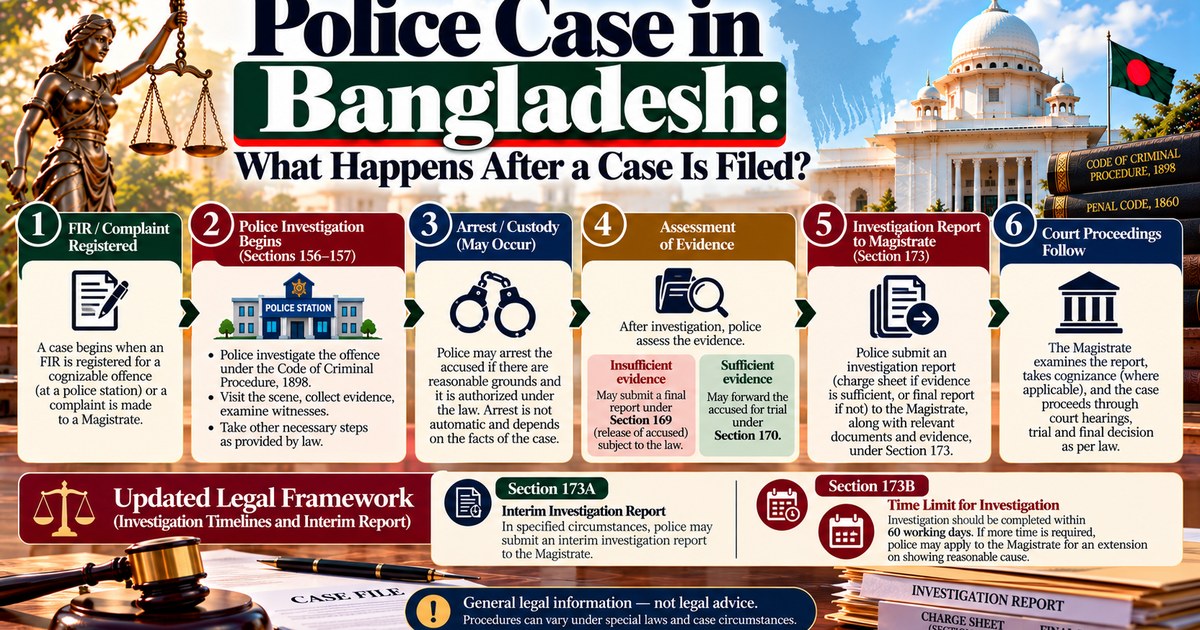
Police Case in Bangladesh: What Happens After a Case Is Filed?
When a person reports a criminal offence to the police in Bangladesh, the matter may enter the criminal justice system through a police case. For a cognizable offence, section 154 of the Code of Criminal Procedure, 1898 (CrPC) provides the framework for recording information at the police station. The police may then investigate the case and submit a report to the appropriate Magistrate.
But filing a police case is only the beginning.
After registration, several stages may follow, including police investigation, evidence collection, witness examination, arrest or bail where legally applicable, police report, cognizance by the court, discharge or framing of charge, trial, judgment and possible appeal or revision.
This guide explains what happens after a police case is filed in Bangladesh, the role of the police and courts, what an accused and complainant can expect, and what legal remedies may be available during the process.
What Is a Police Case in Bangladesh?
The expression "police case" is commonly used to describe a criminal proceeding that originates from information given to the police and is investigated through the police.
For a cognizable offence, section 154 CrPC provides that information given to the officer in charge of a police station must be recorded according to the statutory procedure.
A simplified process is:
Offence → Information to Police → FIR/Police Case → Investigation → Police Report → Court Proceedings → Trial → Judgment
The exact procedure depends on the offence, the applicable law and the circumstances of the case.
What Is the Difference Between a Police Case and a Complaint Case?
A police case generally originates from police-recorded information and investigation.
A complaint case, on the other hand, is initiated before a Magistrate through a criminal complaint.
The two procedures can sometimes interact. For example, section 156(3) allows an empowered Magistrate to order investigation of a cognizable case, while section 205D contains provisions for situations where a complaint case and police investigation concerning the same offence are both pending.
Therefore:
Police case → Police investigation is central
Complaint case → Magistrate's complaint procedure is central
What Happens Immediately After a Police Case Is Filed?
Once information concerning a cognizable offence has been formally recorded, the police may begin investigation.
Section 156 permits the officer in charge of a police station to investigate a cognizable case without an order from a Magistrate, subject to the statutory jurisdictional requirements. Section 157 then provides for reporting the suspected offence to the appropriate Magistrate and proceeding with investigation.
The process may therefore move from:
FIR → Investigation → Evidence collection → Police report → Court
Step 1: Police Register the Case
For information concerning a cognizable offence, section 154 requires the information to be recorded. If the information is given orally, it must be reduced to writing, read over to the informant and signed by the person giving it.
The resulting police record becomes an important part of the case.
The informant should keep the relevant:
Police station details
Case number
Date of registration
Copies of documents
Other available reference information
Step 2: The Police Start the Investigation
Investigation is one of the most important stages after a police case is filed.
Under section 156, police may investigate a cognizable case without a Magistrate's prior order where the statutory requirements are satisfied.
The investigation may include:
Visiting the place of occurrence
Examining witnesses
Collecting documents
Recovering physical evidence
Examining electronic evidence
Recording statements
Obtaining medical evidence
Obtaining expert evidence
Identifying suspects
Taking other lawful investigative measures
The purpose is to determine the facts and collect evidence relevant to the alleged offence.
Step 3: Police May Visit the Place of Occurrence
Section 157 provides that where the officer in charge has reason to suspect the commission of an offence that the police are empowered to investigate, the officer proceeds with the investigation and may go to the place of occurrence or direct a subordinate officer to do so.
Depending on the case, investigators may examine:
The physical location
CCTV systems
Documents
Vehicles
Weapons or other objects
Digital devices
Surrounding circumstances
Potential witnesses
Step 4: Witnesses May Be Examined
Witnesses can play a major role in a criminal investigation.
Section 160 allows an investigating police officer, by written order, to require the attendance of certain persons who appear to be acquainted with the circumstances of the case. Section 161 deals with examination of persons by police during investigation.
Potential witnesses may therefore be asked about:
What they saw
What they heard
When they became aware of the incident
Who was present
Documents or objects they observed
Other relevant circumstances
Step 5: Police Collect Evidence
The investigation may involve several forms of evidence.
Documentary Evidence
Examples include:
Contracts
Receipts
Bank records
Letters
Official documents
Medical records
Physical Evidence
This may include:
Weapons
Damaged property
Clothing
Objects recovered from the scene
Other relevant physical materials
Digital Evidence
Depending on the case, investigators may examine:
CCTV footage
Mobile-phone information
Messages
Emails
Digital files
Social-media material
The admissibility and evidentiary value of particular material depends on the applicable law.
Step 6: The Police May Arrest an Accused
A police case does not automatically mean that every accused person will be arrested.
Arrest is governed by separate legal requirements.
The current section 54 CrPC contains specific conditions governing arrest without warrant in cognizable cases, including circumstances involving reasonable complaint, credible information or reasonable suspicion and additional statutory conditions.
Therefore:
Police case ≠ Automatic arrest
Whether an arrest is lawful depends on the facts and applicable statutory requirements.
What Happens After Arrest?
If a person is arrested, the criminal procedure concerning custody, production before a Magistrate and bail may become relevant.
The 2026 amendments to the CrPC also introduced additional provisions concerning arrest and detention, including section 167A on applications to show a person already in custody in another case as arrested in a different case.
The precise procedure depends on the circumstances.
Step 7: Bail May Become an Issue
An accused who is arrested may seek release on bail where the law permits.
The CrPC distinguishes between bailable and non-bailable offences and provides different statutory rules concerning bail.
The availability of bail depends on matters such as:
Nature of the offence
Applicable statutory provisions
Facts of the case
Evidence
Procedural stage
Previous orders
Other relevant circumstances
Bail is not an acquittal.
Bail means release subject to the applicable legal conditions; it does not determine guilt or innocence.
Step 8: The Investigation Diary Is Maintained
During investigation, the investigating police officer maintains a case diary.
Section 172 requires police officers conducting an investigation to make day-to-day entries concerning matters including when information was received, when investigation began and ended, places visited and circumstances ascertained during the investigation.
The case diary is different from the FIR.
FIR
Records information concerning the alleged cognizable offence.
Case Diary
Records the progress and proceedings of the police investigation.
They should not be treated as the same document.
Step 9: Police Complete the Investigation
Section 173 provides that an investigation should be completed without unnecessary delay and that, once completed, the officer in charge forwards a report to the Magistrate empowered to take cognizance of the offence on a police report.
The report contains information prescribed by law, including the names of parties, nature of the information and persons acquainted with the circumstances of the case.
New Investigation Timeline Under the 2026 Amendment
An important recent development in Bangladesh's criminal procedure is the insertion of section 173B through the Code of Criminal Procedure (Amendment) Act, 2026.
Section 173B provides that, subject to the statutory framework, an investigation is to be completed within 60 working days from the date of receipt of information relating to the offence. Where the investigation cannot reasonably be completed within that period, the investigating officer must record reasons for the delay in the case diary and apply to the Magistrate for an extension, stating the specific grounds and additional time required.
This is an important distinction from older explanations of Bangladesh criminal procedure that simply stated that investigations should be completed "without unnecessary delay."
The current law should be checked when advising on a particular case, especially because special laws may contain different provisions.
Step 10: Interim Investigation Report May Be Possible
The current CrPC also contains section 173A, concerning an interim investigation report.
Before completion of an investigation, the supervising police authority may require an interim report concerning the progress of the investigation. If the report indicates insufficient evidence against a particular accused, the supervising authority may direct submission of the report to the Magistrate or Tribunal, which may discharge that accused if satisfied and subject to the statutory conditions.
Importantly, discharge at this stage does not necessarily prevent the person's name from appearing in the final police report if sufficient substantive evidence later emerges.
Step 11: Police Submit Their Report
After completing the investigation, the police submit the report required by section 173.
The report may indicate the investigative findings and the persons against whom the police propose that proceedings continue.
The court then considers the matter under the applicable criminal procedure.
It is important to understand:
FIR/Police Case ≠ Charge Sheet
The FIR begins the police-case process, while the police report is submitted after investigation.
What Is Commonly Called a Charge Sheet?
In everyday legal practice, a charge sheet generally refers to a police report indicating that the investigation has produced sufficient grounds to proceed against an accused.
However, the precise procedural consequences depend on the contents of the report and the court's subsequent action.
A simplified sequence is:
FIR → Investigation → Police Report → Cognizance → Charge → Trial
Not every case follows this exact sequence.
What If the Police Find Insufficient Evidence?
The case does not necessarily result in conviction simply because an FIR was filed.
The investigation may produce evidence that is insufficient to proceed against a particular accused.
The current section 173A specifically provides an interim mechanism for discharge in specified circumstances where an interim investigation report indicates insufficient evidence against an accused.
The final outcome depends on the evidence and subsequent court proceedings.
Step 12: The Magistrate Considers the Police Report
After the police report is submitted, the appropriate Magistrate may consider whether to take cognizance according to the applicable provisions.
Section 190 CrPC provides the statutory framework for a Magistrate taking cognizance of offences on a police report, complaint or certain other legally recognised bases.
The exact procedure depends on the offence and the court's jurisdiction.
Step 13: The Accused May Face Discharge or Charge Proceedings
Once the matter reaches the appropriate court, the court may consider whether there is sufficient basis to proceed against the accused.
Depending on the type of trial:
The accused may be discharged where the statutory requirements are satisfied.
A formal charge may be framed where the court finds sufficient grounds to proceed.
The case may then move toward trial.
For example, section 241A provides for discharge in specified Magistrate cases where the charge is considered groundless, while section 242 deals with framing of charge in Magistrate trials.
The procedure is different in Sessions cases.
Step 14: Charge Is Framed
A charge is the formal accusation that the accused is required to face at trial.
It is important to distinguish:
FIR → Initial information
Police report → Investigation findings
Charge → Formal accusation determined by the court
The framing of a charge does not mean that the accused has been convicted.
It means that the case has proceeded to the stage where the formal accusation will be tried.
Step 15: The Trial Begins
Once the case proceeds to trial, evidence becomes central.
Depending on the nature of the case, the trial may involve:
Prosecution evidence
Examination and cross-examination of witnesses
Documentary and physical evidence
Examination of the accused according to law
Defence evidence where applicable
Arguments
Judgment
The exact procedure differs between Magistrate trials, Sessions trials and cases under special laws.
Step 16: Prosecution Witnesses Give Evidence
The prosecution presents evidence supporting the allegations.
Witnesses may be examined and cross-examined according to the applicable criminal procedure and evidence law.
Evidence may concern:
The alleged incident
Identity of the accused
Sequence of events
Medical findings
Documents
Recovery of property
Digital evidence
Other relevant circumstances
Step 17: The Defence Challenges the Prosecution Case
The accused has the opportunity to contest the prosecution's allegations.
The defence may challenge:
Identity
Reliability of witnesses
Documentary evidence
Recovery evidence
Medical evidence
Digital evidence
Investigation procedures
Legal ingredients of the alleged offence
The accused may also present a defence where the applicable procedure permits.
Step 18: Arguments Are Heard
After evidence is completed, the parties may make their legal submissions.
The prosecution may argue that the evidence establishes the required elements of the offence.
The defence may argue that:
The prosecution failed to prove the case
Evidence is unreliable
Witnesses are inconsistent
The accused has been wrongly implicated
The required elements of the offence have not been established
A legal defence applies
The precise arguments depend on the case.
Step 19: The Court Delivers Judgment
At the end of the trial, the court delivers judgment.
The possible outcome may include:
Acquittal
Conviction
Sentence
Other orders permitted by law
A police case therefore does not necessarily end in conviction.
The ultimate outcome depends on the evidence and judicial determination.
What Happens If the Accused Is Acquitted?
An acquittal means that the accused has not been convicted in that proceeding.
Depending on the circumstances and applicable law, an appeal against acquittal may be available.
The existence of an appeal does not mean that the accused should be treated as convicted.
What Happens If the Accused Is Convicted?
If the accused is convicted, the court imposes the punishment prescribed by the applicable law.
Depending on the offence, punishment may include:
Imprisonment
Fine
Both imprisonment and fine
Other legally prescribed punishment
The convicted person may have a statutory right of appeal or another legal remedy depending on the judgment and applicable law.
Legal Remedies After a Police Case Is Filed
Several legal remedies may become relevant during or after a police case.
1. Bail
An accused person may seek bail where permitted by law.
2. Discharge
At certain stages, the accused may seek or receive discharge where the statutory requirements are satisfied.
3. Appeal
An appeal may be available against certain judgments and orders where the law provides for one.
4. Revision
Revision is a supervisory remedy available under the applicable provisions of criminal procedure.
5. Inherent Jurisdiction
Section 561A CrPC preserves the High Court Division's inherent power to make orders necessary to give effect to an order under the Code, prevent abuse of the process of a court or otherwise secure the ends of justice.
The availability of a particular remedy depends on the stage and circumstances of the case.
What Can a Complainant Do During Investigation?
A complainant or informant should preserve relevant evidence and cooperate with lawful investigation.
Practical steps include:
Keeping copies of important documents
Preserving photographs and videos
Maintaining medical records
Providing relevant witness information
Keeping track of the case number
Recording important developments
Obtaining legal advice where necessary
The complainant should not attempt to fabricate evidence or improperly influence witnesses.
What Can an Accused Person Do After a Police Case Is Filed?
An accused person should take the case seriously and obtain appropriate legal advice.
Practical steps may include:
Obtain Case Information
Find out:
Police station
Case number
Date of registration
Alleged offences
Names of accused persons
Current investigation status
Consult a Lawyer
A lawyer can examine the FIR, available documents and applicable law.
Consider Bail
If arrest or custody is an issue, determine whether bail is available.
Preserve Defence Evidence
Relevant documents, communications, records and other lawful evidence should be preserved.
Comply With Court Orders
Ignoring court proceedings can create additional legal complications.
Avoid Witness Intimidation
Do not threaten or improperly influence complainants or witnesses.
Can the Police Add or Remove the Name of an Accused?
The contents of the FIR are not necessarily the final determination of who will face trial.
The investigation may produce evidence concerning additional persons or show insufficient evidence against a person initially named.
The current section 173A expressly recognises an interim mechanism under which a person may be discharged for insufficient evidence, while allowing their name to be included in the final police report if sufficient substantive evidence later emerges.
The final position depends on the investigation and court proceedings.
Can a Police Case Be Cancelled?
There is no universal rule that allows an informant to simply cancel a police case by requesting the police to do so.
The available legal mechanisms depend on:
Nature of the offence
Stage of investigation
Evidence
Whether the offence is compoundable
Court proceedings
Applicable special law
In appropriate circumstances, legal remedies may be available before the competent court.
Can a Police Case Be Quashed?
In appropriate circumstances, criminal proceedings may be challenged before the High Court Division under its applicable jurisdiction, including the inherent jurisdiction preserved by section 561A CrPC.
However, quashing is not automatic merely because an accused disputes the allegations.
The court considers the facts and applicable legal principles.
How Long Does a Police Case Take in Bangladesh?
The total duration of a police case can vary considerably.
However, the current law contains an important investigation timeline.
Under section 173B, investigations are to be completed within 60 working days from receipt of information relating to the offence, subject to the statutory extension procedure where reasonable cause prevents completion within that period. The investigating officer must record reasons for delay and apply to the Magistrate for additional time.
It is important to distinguish:
Investigation period ≠ Total case duration
Even after investigation is completed, the matter may proceed through:
Cognizance
Discharge/charge
Evidence
Arguments
Judgment
Appeal
Revision
Other proceedings
Therefore, the total lifetime of a police case may extend beyond the investigation period.
What Happens If the Investigation Takes Longer Than 60 Working Days?
Section 173B does not simply mean that every investigation automatically ends on the 61st working day.
Where there is reasonable cause for delay, the investigating officer must record the reasons in the case diary and apply to the Magistrate for an extension, stating the grounds and additional time required.
Therefore, the statutory framework allows for extensions where the legal requirements are satisfied.
Police Case vs FIR
These terms are often used interchangeably in everyday conversation, but there is a distinction.
FIR
The FIR is the recorded information concerning a cognizable offence under section 154.
Police Case
"Police case" is a broader practical expression describing the criminal proceeding arising from information given to police and investigated as a police case.
A simplified relationship is:
FIR → Police investigation → Police report → Court case
Therefore, the FIR is an important part of a police case, but the entire police case consists of much more than the FIR.
Police Case vs GD
A GD (General Diary) is a police record with a broader recording function.
An FIR concerns information relating to a cognizable offence under section 154.
Therefore:
| GD | Police Case/FIR |
|---|---|
| General police record | Criminal case process |
| May record various incidents and information | Concerns alleged offence under applicable criminal procedure |
| Does not automatically start a criminal investigation | Cognizable police case proceeds to investigation |
| May concern lost property or other information | May lead to police report and court proceedings |
A GD does not automatically become an FIR.
Police Case vs Complaint Case
| Police Case | Complaint Case |
|---|---|
| Originates through police information | Originates through complaint to Magistrate |
| Police investigation is central | Magistrate's complaint procedure is central |
| Police report may follow | Complaint procedure under CrPC |
| Court proceedings may follow police report | Court may proceed under complaint provisions |
The two processes can interact where the same offence is the subject of both police investigation and complaint proceedings.
Common Misconceptions About Police Cases
"Once an FIR is filed, the accused is guilty."
False.
An FIR contains information about an alleged offence. Guilt is determined through the judicial process.
"An FIR automatically means arrest."
False.
Arrest is governed by separate statutory requirements.
"The police report automatically means conviction."
False.
A police report is part of the investigative process. The court determines the case according to law.
"A police case always ends with a trial."
Not necessarily.
Depending on the circumstances, the matter may end or change course through discharge, legal intervention, withdrawal or other mechanisms recognised by law.
"The investigation period and the entire case duration are the same."
No.
The current section 173B addresses the investigation period, while court proceedings may continue afterward.
Frequently Asked Questions
What happens after a police case is filed in Bangladesh?
The police may begin investigation, collect evidence, examine witnesses and take other lawful investigative steps. After completing the investigation, the police submit a report to the appropriate Magistrate under section 173.
Does filing a police case mean the accused will be arrested?
No. Arrest is governed by separate statutory requirements and is not automatic merely because a police case has been registered.
What happens after the FIR?
The police generally investigate the alleged cognizable offence. The investigation can involve witnesses, documents, physical evidence and other relevant material.
What is a police report?
A police report is the report submitted to the appropriate Magistrate after investigation under section 173 CrPC.
What is a charge sheet?
The term commonly refers to a police report supporting continuation of proceedings against an accused after investigation. The precise procedural effect depends on the contents of the report and subsequent court action.
How long does police investigation take in Bangladesh?
Under current section 173B, investigation is generally to be completed within 60 working days, subject to the statutory procedure for obtaining an extension where reasonable cause prevents completion within that period.
Can the investigation take longer than 60 working days?
Yes. Where reasonable cause exists, the investigating officer may apply to the Magistrate for an extension after recording the reasons for delay and specifying the additional time required.
Can an accused be discharged during investigation?
The current section 173A provides an interim-investigation mechanism under which, in specified circumstances, a Magistrate or Tribunal may discharge an accused where an interim report indicates insufficient evidence, subject to the statutory conditions.
Can a person who was discharged later be included in the case?
Under section 173A, discharge during the interim stage does not prevent the investigating officer from including the person's name in the final police report if sufficient substantive evidence later emerges.
What happens if the police find no sufficient evidence?
The investigation and police report deal with the evidence gathered. Depending on the stage and circumstances, statutory mechanisms may allow an accused to be discharged or the case to proceed differently.
Can a complainant withdraw a police case?
There is no universal rule allowing a complainant simply to cancel every police case. The possibility depends on the offence, stage of proceedings and applicable law.
Can a police case be quashed?
In appropriate circumstances, criminal proceedings may be challenged before the High Court Division under its applicable jurisdiction. The availability of relief depends on the facts and governing law.
Can a police case and complaint case exist for the same offence?
They can interact in certain circumstances. Section 205D contains a procedure for situations where a complaint case and police investigation concern the same offence.
Does the police report decide guilt?
No. A police report is an investigative report. The court determines criminal liability through the applicable judicial process.
Final Takeaway
A police case in Bangladesh does not end when the FIR is filed. Registration is generally the beginning of a longer legal process.
The basic sequence is:
1. Information is given to police
2. Police case/FIR is registered where the statutory requirements apply
3. Police investigate
4. Witnesses and evidence are examined
5. Arrest or bail issues may arise where legally applicable
6. Police prepare their investigation report
7. Magistrate considers cognizance
8. The accused may face discharge or charge proceedings
9. Trial takes place where the case proceeds
10. Court delivers judgment
11. Appeal, revision or other remedies may follow where available
A major recent development is that the current CrPC now provides a 60-working-day investigation framework under section 173B, while allowing applications for additional time where reasonable cause exists. It also contains an interim investigation mechanism under section 173A for specified cases involving insufficient evidence against an accused.
Most importantly, filing a police case does not establish guilt, and being named in an FIR does not by itself amount to conviction. The investigation, evidence and subsequent judicial process determine the outcome.
Anyone involved in a police case—whether as complainant, accused or witness—should preserve relevant evidence and obtain case-specific advice from a qualified lawyer where the matter involves arrest, serious offences, bail, disputed evidence or court proceedings.
Authoritative Legal Sources
Code of Criminal Procedure, 1898 — Bangladesh Laws
Sections 154–173 — Information to Police and Investigation
Code of Criminal Procedure (Amendment) Act, 2026
Section 173A — Interim Investigation Report
Disclaimer: This article provides general legal information about police cases in Bangladesh and is not a substitute for case-specific legal advice. Criminal procedure may differ under special legislation, and the applicable law should be verified at the time of taking legal action.