

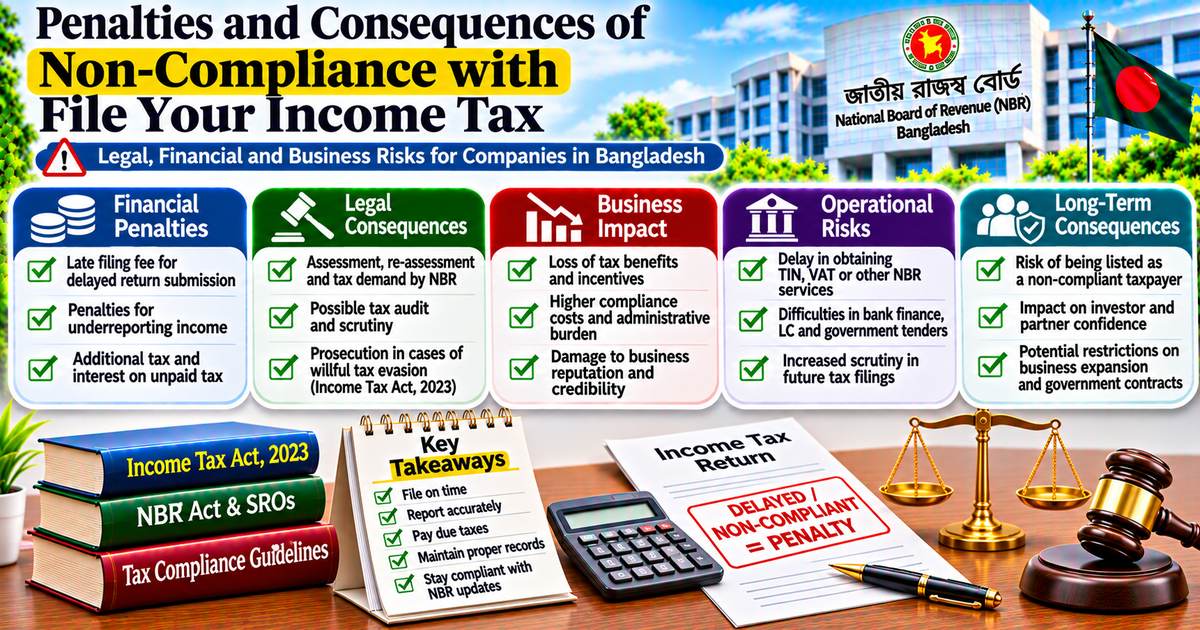
Penalties and Consequences of Non-Compliance with Income Tax Filing in Bangladesh: A Corporate Legal Guide
Introduction
Income tax compliance is a statutory responsibility for businesses operating in Bangladesh. Companies must identify their filing obligations, submit accurate returns, pay applicable taxes and comply with relevant reporting requirements.
Failure to meet these obligations can create significant financial and legal consequences. Depending on the circumstances, a business may face penalties for late filing, additional tax, interest, recovery proceedings, assessment disputes or criminal prosecution.
The Income Tax Act, 2023 provides separate provisions for different forms of non-compliance. It is therefore important to distinguish between an administrative default, an unpaid tax liability, an inaccurate declaration and deliberate tax evasion.
This article examines the principal penalties and consequences businesses should understand before filing their income tax returns.
1. Failure to File an Income Tax Return
One of the most direct compliance risks is failure to submit a return when required by law.
Section 266 of the Income Tax Act, 2023 provides for a penalty where a person, without reasonable cause, fails to file a return required under specified provisions of the Act.
The general penalty under section 266(1) is:
10% of the tax imposed on the last assessed income.
A minimum penalty of Tk 1,000.
An additional Tk 50 for every day during which the default continues.
Importantly, the statutory maximum limits in the proviso to section 266(1) specifically refer to individual taxpayers. They should not automatically be applied to companies or other non-individual taxpayers. <Cite refs={["turn888677view1","turn715467view1"]}/>
Corporate implication: A company should not assume that the penalty exposure is capped at the individual taxpayer limits. Its legal status and the precise wording of the applicable provision must be considered.
2. Additional Tax for Filing After the Tax Day
Late filing can have a financial consequence separate from the penalty under section 266.
Section 174 of the Income Tax Act, 2023 provides a formula for calculating tax where a person required to file under section 166 fails to submit the return within the tax day.
The statutory formula is:
[
A=B+(B-C)\times D\times 0.02
]
Where:
A = Total amount of tax payable.
B = Tax that would have been payable if the return had been filed on the tax day, calculated under the statutory conditions.
C = Aggregate advance tax and tax deducted at source paid during the income year.
D = Number of months after expiry of the tax day, with a maximum of 24 months. A fraction of a month counts as a full month.
This is a statutory calculation, not simply a flat 2% penalty on the entire tax liability. <Cite refs={["turn888677view0"]}/>
Corporate implication: Businesses should calculate the potential cost of delayed filing and plan their tax payments before the statutory deadline.
3. Failure to Respond to NBR Notices
A company may receive notices requiring it to provide documents, information, explanations or other evidence.
Section 270 provides for a penalty where a person, without reasonable cause, fails to comply with specified notices issued under sections 167, 168, 179, 181, 183 or 212.
The penalty may be up to the amount of tax chargeable on the person's total income. <Cite refs={["turn888677view1"]}/>
Examples of situations requiring attention include:
Failure to provide requested accounting records.
Ignoring a notice requesting supporting documents.
Failure to respond to an assessment-related notice.
Failure to provide relevant explanations within the prescribed period.
Corporate implication: All NBR notices should be recorded, assigned to a responsible officer and responded to within the applicable period.
4. Failure to Pay Admitted Tax Liability
Submitting a return does not complete a company's tax obligations if the admitted tax liability remains unpaid.
Section 271 addresses failure to pay tax admitted by the taxpayer.
Where the statutory conditions are satisfied, the Deputy Commissioner of Taxes may impose a penalty of up to:
25% of the whole tax liability; or
25% of the relevant unpaid portion, as applicable under the provision.
<Cite refs={["turn888677view2"]}/>
Businesses should therefore reconcile the tax payable in the return with advance tax, withholding tax credits and actual payment evidence.
5. Default in Payment of Tax
Section 275 provides a further penalty framework for taxpayers who default in paying tax or are deemed to be in default.
The Deputy Commissioner of Taxes may direct collection of a penalty in addition to the unpaid tax, but the penalty cannot exceed the unpaid tax itself. <Cite refs={["turn371366view2"]}/>
The company may also face recovery proceedings under the applicable provisions of the Act.
Corporate implication: An unpaid tax demand should be treated as a financial and legal exposure requiring prompt attention, not merely as an outstanding accounting balance.
6. Concealment of Income and Misrepresentation
One of the more serious areas of non-compliance involves deliberately misrepresenting income, assets, liabilities, expenses or other material information to evade tax.
Section 272 addresses penalties for concealment of income.
Following the amendment made by the Finance Act, 2026, the penalty is calculated as:
[
\text{Penalty}=\text{Tax evaded}\times10%\times\text{Number of years}
]
The number of years is calculated from the assessment year in which the evasion occurred through the assessment year in which it was discovered, inclusive. <Cite refs={["turn715467view2","turn565096search3"]}/>
Examples of potentially serious conduct include:
Deliberately concealing sales or other income.
Falsely reporting business expenses.
Misrepresenting assets or liabilities.
Providing materially false information to reduce tax liability.
Creating misleading accounting records.
A genuine accounting error is not automatically equivalent to deliberate concealment. The statutory requirements concerning misrepresentation and tax evasion must be established.
7. Failure to Deduct or Deposit Tax at Source
Businesses responsible for withholding tax must comply with the applicable deduction, collection and deposit requirements.
Section 143 addresses the consequences of failure to deduct, collecting at a lower rate or failing to deposit tax already deducted or collected.
Depending on the default, the responsible person may be required to pay:
The tax that should have been deducted or collected.
The shortfall where tax was deducted or collected at a lower rate.
Tax deducted or collected but not deposited.
An additional amount at 2% per month on specified unpaid amounts, subject to the statutory period and conditions.
A penalty of up to Tk 10 lakh for certain other non-compliance under the section.
The Act also contains provisions concerning joint or several responsibility in relevant circumstances. <Cite refs={["turn715467search33","turn371366view4"]}/>
Section 315 separately provides criminal consequences for specified withholding tax defaults without reasonable cause. <Cite refs={["turn888677view3"]}/>
Corporate implication: Withholding tax should be monitored transaction by transaction. A company should not assume that filing its annual income tax return automatically resolves its separate withholding obligations.
8. Criminal Consequences for Wilful Tax Evasion
Not every tax default is a criminal offence. However, deliberate attempts to evade tax can result in criminal prosecution.
Section 312 provides that a person who wilfully attempts to evade tax payable under the Act may face:
Imprisonment for a term of at least six months and up to five years;
A fine; or
Both imprisonment and a fine.
The provision identifies conduct such as concealing income and wilfully providing false information about assets, liabilities or expenses to reduce tax liability. <Cite refs={["turn888677view3","turn715467search0"]}/>
Businesses should distinguish between an inadvertent reporting mistake and intentional conduct designed to evade tax.
9. False or Fake Audit Reports
Companies required to submit audited financial statements should ensure that their audit reports are genuine and properly certified.
The Income Tax Act contains specific provisions addressing incorrect, false or fake audit reports.
For example:
Section 273 provides a penalty of Tk 50,000 to Tk 2 lakh for a Chartered Accountant where the specified statutory conditions concerning an incorrect or false audit report are established.
Section 274 provides a Tk 1 lakh penalty for a taxpayer furnishing a fake audit report in the circumstances specified by the Act.
Section 316 addresses criminal punishment for knowingly filing a fake or false audited statement, with imprisonment ranging from six months to five years.
<Cite refs={["turn888677view2","turn888677view3"]}/>
Corporate implication: Management should verify that financial statements and audit reports are properly prepared and certified. An audit report should never be treated as a document that can simply be obtained to complete a filing requirement.
10. Consequences for Directors and Responsible Officers
A company is a separate legal entity, but certain offences committed by a company may create exposure for individuals directly responsible for its management.
Section 323 addresses offences committed by a company, firm or association of persons.
Under the provision:
The company, firm or association may be fined.
Individuals directly responsible for management may face imprisonment and a fine under the statutory conditions.
The law also recognises a defence where the responsible person establishes the specified absence of knowledge, consent and negligence.
The prescribed imprisonment for the responsible person under section 323 may extend to six years, subject to the statutory minimum and other requirements. <Cite refs={["turn888677view3"]}/>
This does not mean every director is automatically criminally liable for every company tax default. The individual's actual responsibility and the statutory requirements must be examined.
11. Failure to Display Proof of Return Submission
Businesses should also be aware of the separate requirement under section 265.
An assessee having business income and obliged to submit an income tax return must display proof of return submission at a conspicuous place at the business premises.
Failure to comply may attract a penalty ranging from Tk 20,000 to Tk 50,000. <Cite refs={["turn888677view1"]}/>
This requirement is distinct from filing the return itself.
Corporate implication: After filing, businesses should ensure that the relevant proof of return submission is properly displayed where the statutory requirement applies.
12. Failure to Maintain Proper Accounts and Records
A business should maintain accounting records in accordance with the applicable law and requirements.
Section 267 provides for penalties for failure to maintain accounts in the prescribed manner in specified circumstances.
The potential penalty depends on the nature of the taxpayer's income and the relevant statutory conditions. <Cite refs={["turn888677view1"]}/>
Poor record-keeping may also create difficulties when the company needs to:
Substantiate its income.
Support business expenses.
Reconcile tax payments.
Explain related-party transactions.
Respond to an NBR notice.
Defend its tax computation during assessment.
A company should maintain an organised record-retention system rather than attempting to reconstruct transactions after receiving a notice.
13. Potential Business and Commercial Consequences
The consequences of tax non-compliance are not limited to statutory penalties.
A company may also experience commercial and operational difficulties.
A. Financing difficulties
Banks and financial institutions may request tax returns and other financial documents when evaluating financing applications.
Unresolved tax liabilities or incomplete records may complicate the review process.
B. Investor due diligence concerns
Investors may examine a company's tax compliance history before making an investment.
Unresolved tax disputes or unsupported financial statements can affect their assessment of risk.
C. Regulatory complications
Failure to meet applicable return submission and tax-related documentation requirements may create difficulties in transactions or applications where proof of return submission is required.
D. Management and operational costs
Tax disputes, additional assessments and document requests can consume management time and professional resources.
E. Reputational concerns
Serious or repeated compliance failures can weaken confidence among lenders, investors, customers and business partners.
These are potential commercial consequences, not automatic legal penalties.
14. What Should a Company Do After Discovering Non-Compliance?
If a company identifies a tax compliance problem, it should respond systematically.
Step 1: Identify the nature of the default
Determine whether the issue concerns late filing, unpaid tax, withholding tax, incorrect reporting or failure to respond to a notice.
Step 2: Review the relevant statutory provision
Identify the applicable section, time limit and possible consequence.
Step 3: Collect supporting documents
Gather accounting records, invoices, bank statements, payment challans, tax certificates and previous returns.
Step 4: Calculate the potential exposure
Estimate unpaid tax, additional amounts, penalties and any relevant interest.
Step 5: Consider the available corrective procedure
Review whether late filing, revised filing, payment, an explanation or another statutory remedy is available.
Step 6: Obtain professional advice
Where the matter involves significant tax exposure, a formal notice or a potential offence, seek advice from a qualified tax or legal professional.
Step 7: Document the corrective action
Maintain a clear record of the issue, management decision, payments, correspondence and final resolution.
15. The Importance of Reasonable Opportunity of Being Heard
A company should not assume that every proposed penalty becomes final automatically.
Section 280 provides that an order imposing a penalty under Part 19 cannot be made unless the taxpayer has been heard or given a reasonable opportunity of being heard. <Cite refs={["turn371366view3"]}/>
This is an important procedural protection.
If the company receives a proposed penalty or related notice, it should:
Read the notice carefully.
Identify the legal provision relied upon.
Check the facts and supporting evidence.
Prepare a written response where appropriate.
Attend the hearing or comply with the prescribed procedure.
Retain copies of all submissions and decisions.
A hearing opportunity does not eliminate a valid tax liability or guarantee that a penalty will be withdrawn. It ensures that the taxpayer has an opportunity to present its case.
16. Corporate Tax Compliance Checklist
Companies can use the following checklist to reduce the risk of non-compliance.
| Compliance area | Recommended control |
|---|---|
| Annual income tax return | Maintain a filing calendar |
| Tax payments | Reconcile tax payable and paid amounts |
| Withholding tax | Review deductions and deposits regularly |
| Financial statements | Maintain reliable accounting records |
| NBR notices | Assign a responsible officer |
| Tax computation | Conduct an independent review |
| Audit reports | Verify proper certification |
| Tax incentives | Document legal eligibility |
| Related-party transactions | Maintain supporting records |
| Proof of return submission | Display where required |
| Tax disputes | Track notices, hearings and appeal deadlines |
| Management oversight | Report material tax risks to directors |
Conclusion
Non-compliance with income tax obligations can create substantial financial, regulatory and legal risks for businesses in Bangladesh.
The Income Tax Act, 2023 provides different consequences for failure to file returns, delayed filing, unpaid tax, withholding tax defaults, concealment of income and deliberate tax evasion.
The most effective way to reduce these risks is to maintain accurate accounts, comply with filing and payment deadlines, monitor withholding tax obligations and respond promptly to NBR notices.
The Justice Corner assists businesses with corporate tax compliance, tax risk assessment and legal advisory matters. Early professional review can help companies identify potential exposure and take appropriate corrective action.