

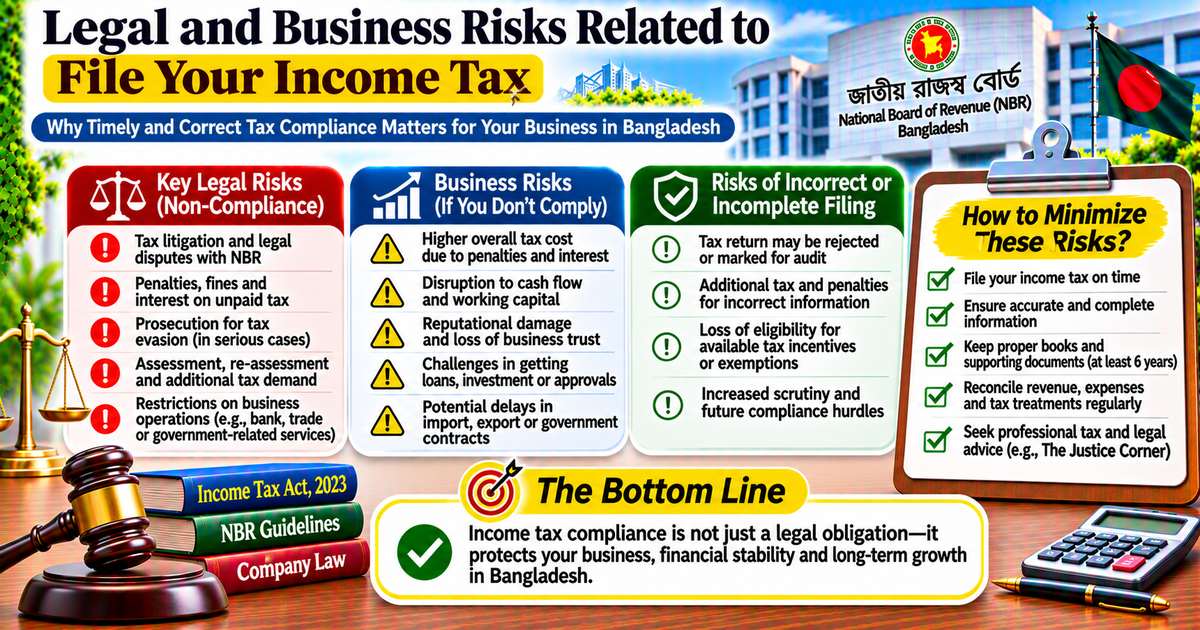
Legal and Business Risks Related to Filing Your Income Tax in Bangladesh
Introduction
Income tax compliance is not simply an annual accounting exercise for businesses operating in Bangladesh. It is a statutory responsibility that can directly affect a company's financial position, regulatory standing, reputation and long-term commercial operations.
An inaccurate return, failure to disclose income, unsupported expense claims, late submission or incorrect withholding tax treatment may expose a business to financial penalties, additional tax liabilities and, in serious circumstances, criminal proceedings.
The risks are not limited to companies. Directors, responsible officers, finance personnel and other individuals involved in tax-related decisions may also face consequences where the law establishes personal responsibility or an offence.
Bangladesh's Income Tax Act, 2023, together with its amendments and applicable rules, provides the framework for these obligations.
This article examines the principal legal and business risks associated with income tax filing and explains how companies can reduce their exposure.
1. Failure to File an Income Tax Return
One of the most fundamental compliance risks is failing to submit a return when required by law.
Section 166 of the Income Tax Act, 2023 establishes return submission obligations for specified taxpayers.
Companies should not assume that they are exempt from filing simply because:
They have not generated revenue.
They have incurred a business loss.
They have temporarily suspended operations.
Their business activity has been limited.
They have not distributed profits to shareholders.
The filing obligation must be assessed based on the company's legal status and applicable provisions.
Legal consequences
Section 266 provides for penalties where a person, without reasonable cause, fails to submit a required return under the specified provisions.
Under section 266(1), the penalty may amount to 10% of the tax imposed on the last assessed income, subject to a minimum of BDT 1,000. An additional BDT 50 per day may apply while the default continues, subject to the statutory provisions and applicable limits.
The exact penalty must be assessed according to the taxpayer's category, previous assessment history and current law.
Business risk: Failure to file can create uncertainty over the company's tax position and complicate future financing, regulatory applications and due diligence.
2. Incorrect or Incomplete Disclosure of Income
A company must ensure that its return accurately reflects its taxable income and relevant financial information.
Common disclosure problems include:
Omitting business receipts.
Underreporting sales.
Misclassifying income.
Failing to disclose relevant financial transactions.
Incorrectly reporting assets or liabilities.
Claiming expenses that were not actually incurred.
Providing misleading supporting information.
Legal consequences
Section 272 addresses penalties for concealment of income through misrepresentation of income, assets, liabilities, expenses or other important information relating to tax payable.
The statutory penalty is calculated using:
15% of the tax evaded; plus
10% of the tax evaded multiplied by the number of years from the relevant assessment year to the year in which the evasion is discovered.
This is a specific statutory penalty for established tax evasion through misrepresentation, not an automatic charge for every accounting mistake.
Section 312 also provides criminal consequences for a person who wilfully attempts to evade tax. The prescribed punishment may include imprisonment for six months to five years, a fine or both, subject to the statutory requirements.
Business risk: Deliberate concealment can create serious financial, legal and reputational consequences for a company and potentially the individuals involved.
3. Incorrect Expense Claims and Unsupported Deductions
Expense claims are an important part of corporate tax computation.
However, an expense recorded in the accounting system is not automatically deductible for income tax purposes.
Potential problem areas include:
Personal expenses recorded as business expenses.
Unsupported cash expenditure.
Duplicate invoices.
Inflated supplier bills.
Expenses without a genuine commercial purpose.
Capital expenditure incorrectly treated as revenue expenditure.
Incorrect depreciation claims.
Expenses prohibited or restricted under applicable tax provisions.
Legal and financial exposure
If an expense is disallowed, the company's taxable income may increase.
This can result in:
Additional tax payable.
Interest or other applicable charges.
Penalties where the statutory conditions are met.
Further examination of the company's accounting records.
Where an expense was deliberately fabricated or falsely claimed to conceal taxable income, the issue may go beyond an ordinary computational error.
Practical recommendation: Maintain invoices, payment evidence, contracts and business-purpose documentation for material expenses.
4. Failure to Deduct or Deposit Tax at Source
Withholding tax is a major compliance responsibility for many companies.
A company making certain payments may be required to deduct or collect tax at source and deposit the amount into the Government Treasury within the prescribed time.
Relevant transactions may include:
Salary and employment-related payments.
Contractor and supplier payments.
Rent.
Professional and consultancy fees.
Commission.
Interest.
Royalties.
Payments to non-residents.
Other transactions specified by law.
Legal consequences
Section 143 addresses consequences where a person fails to deduct or collect tax, deducts or collects a lower amount, or fails to deposit the amount into the Government Treasury.
The statutory framework includes recovery of the relevant tax and an additional amount that may be calculated at 2% per month for the prescribed period, subject to the law.
Section 315 also provides criminal punishment for specified failures involving deduction, collection and deposit of tax at source without reasonable cause. The punishment may include imprisonment for up to one year, a fine or both.
Business risk: Withholding tax failures can create liabilities even where the company has otherwise submitted its annual income tax return correctly.
5. Failure to Pay Tax Within the Applicable Time
Submitting an income tax return does not necessarily mean the company's tax obligations have been fully discharged.
A company must ensure that the admitted tax liability is paid in accordance with the applicable provisions.
Possible consequences
Section 271 provides for a penalty not exceeding 25% of the tax, or the relevant unpaid portion, where the statutory conditions are satisfied.
Section 275 also provides for a penalty in cases of default in payment of tax, in addition to the unpaid tax, subject to the statutory limit.
Other consequences may arise under the applicable tax recovery provisions.
Business risk: Unpaid tax can affect cash flow, create additional financial exposure and complicate the company's dealings with tax authorities.
6. Non-Compliance With NBR Notices
NBR may issue notices requiring a taxpayer to provide documents, information, accounts or explanations.
For example, a company may be required to provide:
Financial statements.
Bank statements.
Sales and purchase records.
Expense vouchers.
Payroll records.
Tax payment evidence.
Details of particular transactions.
Electronic accounting records.
A company should treat every official notice seriously and record the applicable response deadline.
Legal consequences
Section 270 provides for a penalty where a person, without reasonable cause, fails to comply with specified notices.
The penalty may not exceed the amount of tax chargeable on the person's total income, subject to the statutory requirements.
Failure to provide information may also create additional procedural or criminal exposure where the relevant provisions apply.
Practical recommendation: Assign an authorised person to manage NBR communications and maintain evidence of every response.
7. Exposure During Tax Audit and Assessment
A submitted return may be examined under the applicable assessment and audit procedures.
A company should not assume that submission or self-assessment makes the return immune from future scrutiny.
Tax authorities may examine matters such as:
Differences between declared income and financial records.
Unusual expense patterns.
Significant cash transactions.
Related-party payments.
Unsupported deductions.
Withholding tax discrepancies.
Asset and liability movements.
Tax incentives and exemptions claimed.
Where discrepancies are identified, the company may be required to explain its tax position and provide supporting records.
Business consequences
An assessment or audit can lead to:
Additional tax demand.
Penalties and other applicable charges.
Professional and administrative costs.
Management time diverted from operations.
Potential tax disputes and appeals.
A properly maintained accounting and tax documentation system can significantly reduce the difficulty of responding to such proceedings.
8. Risks Associated With Related-Party Transactions
Companies that transact with shareholders, directors, parent companies or other associated enterprises should pay particular attention to related-party arrangements.
Examples include:
Shareholder loans.
Management fees.
Technical service payments.
Royalty payments.
Intercompany purchases.
Shared administrative expenses.
Cross-border financing.
Transactions that are not properly documented or do not comply with applicable transfer pricing requirements may attract additional scrutiny.
Sections 235 and 237–239 of the Income Tax Act, 2023 contain relevant provisions concerning international transactions, information, documentation and reporting.
The Act also provides specific penalties for certain transfer pricing compliance failures.
For example, sections 276–279 address penalties relating to specified international transaction documentation and reporting obligations.
Business risk: Poorly documented related-party transactions can create significant tax exposure, particularly for multinational groups and foreign-invested companies.
9. Personal Liability and Corporate Responsibility
A common misconception is that every tax compliance issue is exclusively the company's responsibility.
The legal position depends on the nature of the offence and the applicable provisions.
Section 323 addresses offences committed by companies, firms and associations of persons.
Under the applicable statutory framework, a company may face a fine, while individuals responsible for the conduct of its business may also face consequences where the relevant legal conditions are satisfied.
This makes it important for directors and senior management to establish appropriate internal controls.
Corporate governance measures
Define tax responsibilities clearly.
Require approval of material tax positions.
Maintain accurate financial records.
Review tax computations before submission.
Monitor withholding tax obligations.
Preserve supporting documentation.
Respond promptly to NBR notices.
Avoid authorising false statements or fabricated documents.
Directors should ensure that tax compliance is treated as a governance matter rather than delegated without oversight.
10. Business and Commercial Risks Beyond Tax Penalties
The consequences of poor tax compliance may extend beyond direct financial penalties.
A. Reputation risk
Tax disputes and serious compliance failures can damage relationships with investors, lenders, suppliers and business partners.
B. Investment and financing difficulties
Investors and lenders often review financial statements, tax returns, tax payment records and outstanding liabilities during due diligence.
Incomplete tax records can delay investment decisions or financing arrangements.
C. Business disruption
Tax assessments, audits and document requests can require substantial management and finance-team attention.
D. Regulatory complications
Certain business transactions, licences or official procedures may require tax-related documentation or evidence of compliance.
The specific requirements depend on the relevant authority and transaction.
E. Increased compliance costs
Correcting historical tax errors often requires additional accounting work, professional fees, documentation and management time.
11. Common Corporate Income Tax Mistakes to Avoid
| Common mistake | Potential consequence |
|---|---|
| Missing a mandatory return | Statutory penalty and further compliance action |
| Underreporting income | Additional tax and possible concealment penalty |
| Claiming fabricated expenses | Tax exposure and possible criminal consequences |
| Incorrect TDS deduction | Recovery, additional charges and potential offence |
| Failing to pay admitted tax | Penalty and recovery action |
| Ignoring NBR notices | Penalty and procedural complications |
| Poor transfer pricing documentation | Additional tax and specific penalties |
| Using false audit documents | Serious financial and legal consequences |
| Mixing personal and company transactions | Accounting and tax disputes |
The consequences depend on the facts, statutory conditions and relevant legal proceedings.
12. How Companies Can Reduce Income Tax Risks
A proactive tax compliance framework is more effective than correcting errors only after receiving an NBR notice.
Companies should consider the following measures.
1. Maintain accurate accounting records
Record all business transactions promptly and reconcile bank accounts regularly.
2. Establish a tax compliance calendar
Track filing deadlines, tax payment dates, withholding tax obligations and other statutory requirements.
3. Review tax computations independently
Have material tax adjustments and claims reviewed by a competent professional before submission.
4. Strengthen withholding tax controls
Identify transactions subject to deduction or collection at source and ensure that the applicable amounts are deposited and reported correctly.
5. Document related-party transactions
Maintain written agreements, commercial justification, invoices and transfer pricing documentation where required.
6. Preserve audit-ready records
Maintain digital and physical copies of invoices, bank statements, contracts, payroll records and financial statements.
7. Respond to NBR communications promptly
Ensure that notices are reviewed and answered within the applicable deadlines.
8. Obtain professional advice on complex matters
Seek assistance before claiming exemptions, restructuring the company or undertaking significant cross-border transactions.
13. How The Justice Corner Can Assist
The Justice Corner provides legal and corporate tax compliance support to businesses operating in Bangladesh.
Our assistance may include:
Corporate income tax return review.
Tax compliance risk assessment.
Tax computation and documentation review.
Withholding tax compliance.
Tax audit preparation.
NBR notice response assistance.
Tax assessment and dispute support.
Transfer pricing compliance support.
Review of tax incentives and exemptions.
Corporate governance and tax risk management.
Early legal and tax review can help businesses identify potential problems before they develop into significant disputes.
Conclusion
Income tax compliance is both a legal obligation and an important business risk management responsibility.
Failure to file, inaccurate disclosure, unsupported expense claims, withholding tax failures, unpaid tax and non-compliance with NBR notices can expose companies to financial penalties and, in serious cases, criminal proceedings.
Businesses should therefore maintain reliable accounting records, implement internal tax controls and obtain professional advice where necessary.
A strong tax compliance framework protects not only the company's financial position but also its reputation, management and long-term commercial interests.
Disclaimer: This article provides general legal and tax information relating to Bangladesh and does not constitute individual legal advice. The consequences of non-compliance depend on the applicable statutory provisions, facts, evidence and legal proceedings. Taxpayers should verify the latest amendments and obtain professional advice before making decisions or responding to tax authority action.