

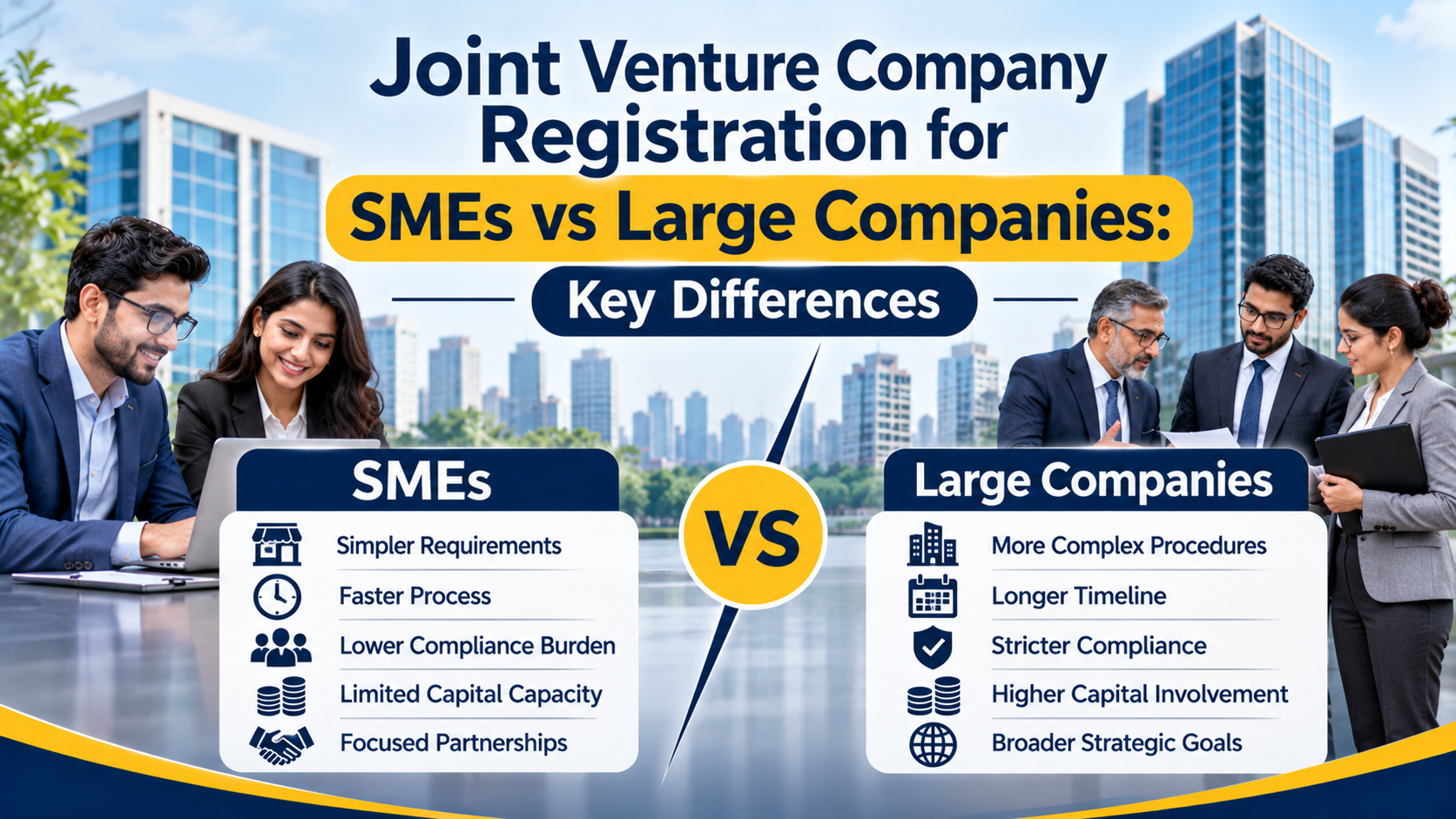
Joint Venture Company Registration for SMEs vs Large Companies: Key Differences in Bangladesh
Joint ventures can help businesses combine investment, technology, expertise and market access. However, the process of establishing a joint venture may look very different for a small or medium-sized enterprise (SME) compared with a large company.
An SME may be entering its first formal investment partnership, working with a foreign technology provider or joining forces with another local business to expand its operations. A large company, on the other hand, may already have established legal, finance and compliance departments, experienced advisers and international business relationships.
These differences affect how the parties prepare for incorporation, negotiate ownership, manage documentation, arrange capital contributions and handle regulatory obligations.
Importantly, Bangladesh does not have a separate RJSC incorporation process simply because a joint venture is classified as an SME or a large business. The legal requirements primarily depend on the chosen company type, ownership structure, business activities and applicable regulatory framework.
Understanding this distinction can help investors select an appropriate structure and avoid unnecessary legal and administrative complications.
1. Understanding the Difference Between SMEs and Large Companies
Before comparing joint venture registration requirements, it is important to understand what qualifies as an SME.
In Bangladesh, SME and CMSME classifications are used in different policy, industrial and financing contexts. Bangladesh Bank's SME and Special Programmes Department supports the development of cottage, micro, small and medium enterprises and publishes relevant SME policies and guidance.
SME & Special Programmes Department+1
The classification of an enterprise may depend on factors such as:
Nature of business activity.
Number of employees.
Fixed asset investment, excluding land and factory buildings where applicable.
Annual turnover, depending on the relevant classification framework.
The applicable definition should be checked against the relevant government policy or regulatory circular.
An important legal distinction: SME classification does not automatically determine whether a business must register as a private limited company, public limited company or another entity. RJSC's company-registration framework distinguishes entities by their legal form, not simply by whether they are small or large businesses.
EBRS+1
For joint venture investors, this means that the first decision should be about the appropriate legal structure, followed by an assessment of the applicable SME or large-enterprise classification.
2. Choosing the Right Company Structure: Private Limited or Public Limited?
For both SMEs and large businesses, choosing the appropriate company structure is more important than the size classification itself.
A private limited company is often suitable when a small number of investors want to establish a jointly owned business with controlled share transfers and private ownership.
Under section 2(1)(q) of the Companies Act, 1994, a private company must restrict the transfer of its shares, prohibit invitations to the public to subscribe for its shares or debentures, and limit its membership to 50, subject to the statutory definition. A public company is defined as a company that is not a private company.
Resource Portal+1
For an SME joint venture: A private limited company may be practical when two or three businesses want to combine resources, share ownership and retain control over who becomes a shareholder.
For a large-company joint venture: A private limited company may still be appropriate, particularly where the venture has a limited number of institutional investors. A public limited structure may be considered where the business has a wider ownership or capital-raising strategy.
A large business does not automatically need to register as a public limited company. The decision should reflect the ownership model, financing plans, governance requirements and applicable law.
3. Differences in Initial Planning and Business Objectives
SMEs and large companies often approach joint ventures with different commercial priorities.
An SME may establish a joint venture to access technology, expand production, enter a new market or obtain additional investment. The partnership may be a major strategic step for the business.
A large company may establish a joint venture to enter another country, develop a new product line, acquire specialised technology, expand its supply chain or undertake a large infrastructure project.
| Planning area | SME joint venture | Large-company joint venture |
|---|---|---|
| Main objective | Business expansion, technology access or additional investment | Strategic expansion, market entry or large-scale operations |
| Number of stakeholders | Usually a smaller group | May involve several corporate investors and institutional stakeholders |
| Decision-making | Often handled directly by owners or directors | May involve boards, committees and senior management |
| Investment planning | Often focused on available capital and immediate business needs | May involve long-term financial modelling and larger funding commitments |
| Legal support | May rely on external legal advisers | May have internal legal teams and external specialist advisers |
| Documentation | Usually more straightforward, depending on the transaction | May involve extensive due diligence and negotiated agreements |
These are common business patterns, not legal rules. An SME entering a foreign investment arrangement may require extensive legal work, while a large company undertaking a simple domestic project may have a relatively straightforward incorporation process.
4. Differences in Capital Contribution and Financial Planning
Capital contribution is one of the most important areas to review before registering a joint venture company.
An SME may have limited financial resources and therefore need to agree carefully on how much each partner will invest. A large company may have access to substantial funding, established banking relationships and more complex financing arrangements.
For an SME joint venture, the partners should pay particular attention to:
Initial paid-up capital.
Each partner's financial contribution.
The timing of capital payments.
Working capital requirements.
Responsibility for additional funding.
Consequences of a partner failing to contribute the agreed amount.
For a large-company joint venture, the financial review may also include:
Long-term investment commitments.
Capital expenditure forecasts.
Project financing arrangements.
Intercompany loans.
Foreign currency exposure.
Financial guarantees.
Investment returns and exit valuations.
Where a foreign investor participates, the applicable foreign exchange and banking requirements must be reviewed regardless of the size of the joint venture.
Bangladesh Bank's Foreign Investment and Financing Portal provides guidance on foreign investment through company formation and the banking procedures relevant to non-resident investment.
Invest Bangladesh+1
The amount of investment may also affect certain project-related registration fees and documentation. Invest Bangladesh publishes industrial project registration fees according to project investment ranges, rather than simply describing a company as an SME or large company.
Invest Bangladesh
5. Differences in Legal Documentation and Due Diligence
Both SME and large-company joint ventures require appropriate legal documentation. However, the scope of document review can vary significantly depending on the parties, investment and project complexity.
Documentation commonly required for both
For a private company, RJSC's published incorporation requirements include:
Memorandum and Articles of Association.
Form I – Declaration on Registration of Company.
Form VI – Notice of Registered Office.
Form IX – Consent of Director to Act.
Form X – List of Persons Consenting to be Directors.
Form XII – Particulars of Directors, Manager and Managing Agents.
Evidence of name clearance.
Applicable stamp and treasury payment documentation.
These requirements apply to private companies under the relevant incorporation framework, not only to large businesses.
EBRS+1
Additional considerations for SME joint ventures
An SME may need to focus on making sure the essential commercial arrangements are properly documented.
Important documents may include:
Joint Venture Agreement.
Shareholding and capital contribution schedule.
Board and shareholder resolutions.
Investor identification and corporate records.
Relevant business licences and tax documents.
Bank records supporting investment contributions.
The agreement should clearly explain how the partners will manage the company, share profits, resolve disagreements and handle a possible exit.
Additional considerations for large-company joint ventures
A large-company transaction may require a broader due diligence exercise, particularly when the partners have multiple subsidiaries, overseas operations or substantial existing liabilities.
Depending on the transaction, the review may cover:
Corporate ownership and group structure.
Existing shareholder agreements.
Financial statements and audited accounts.
Outstanding loans and guarantees.
Existing litigation and regulatory investigations.
Intellectual property ownership.
Material supplier and customer contracts.
Employment and labour obligations.
Environmental and industry-specific compliance.
Related-party transactions.
A larger transaction may also require specialist advice from corporate lawyers, tax advisers, accountants, valuation professionals and industry consultants.
6. Differences in Governance and Management Arrangements
Governance determines how the joint venture company makes decisions and how the partners exercise their rights.
For an SME, the owners may be directly involved in everyday operations. This can make decision-making relatively simple, but it can also create problems if responsibilities are not clearly defined.
For a large-company joint venture, decision-making may involve several levels of management, board committees and formal approval procedures.
| Governance issue | SME joint venture | Large-company joint venture |
|---|---|---|
| Board structure | Often a smaller board | May involve multiple investor representatives |
| Management | Owners may participate directly | Professional management may handle daily operations |
| Approval process | Often more direct | May involve internal committees and formal approvals |
| Financial oversight | May be handled by a smaller finance team | May involve dedicated finance and internal audit functions |
| Reporting | Usually simpler internal reporting | More detailed reporting to investors and group management |
| Reserved matters | Focus on essential ownership and business decisions | May cover a wider range of financial, strategic and operational decisions |
Regardless of company size, the Joint Venture Agreement and Articles of Association should clearly address board representation, voting rights, reserved matters and management authority.
A large investor should not assume that its higher financial contribution automatically gives it unrestricted control. Equally, a smaller investor should understand what decisions it can approve, challenge or veto under the agreed structure.
7. Differences in Regulatory Compliance and Approvals
One common misunderstanding is that smaller companies have fewer legal obligations simply because their operations are limited.
In reality, the applicable requirements depend on the company's legal form, activities, ownership and regulatory status.
Both SME and large-company joint ventures may need to address:
RJSC incorporation and corporate filings.
Trade Licence requirements.
TIN registration and applicable income tax obligations.
VAT registration or enlistment, where applicable.
Employment and labour law compliance.
Environmental and fire safety requirements, where applicable.
Sector-specific permissions.
Foreign investment and banking procedures, where relevant.
For eligible industrial projects, BIDA provides registration services for local, foreign and joint venture investment projects. Its published requirements include incorporation documents, Trade Licence, TIN, project land or rental documents and, for foreign or joint venture projects, an encashment certificate. Controlled sectors may require an NOC from the relevant authority.
Invest Bangladesh+1
The distinction is therefore not simply that an SME has fewer approvals than a large company. A small manufacturing project may require significant regulatory preparation, while a large commercial trading company may not require BIDA industrial project registration.
BIDA's published information states that its industrial project registration is not a requirement for ordinary commercial and trading activities.
bida.portal.gov.bd
8. Differences in Tax and Accounting Management
Tax and accounting arrangements should be considered before the joint venture begins operating.
An SME may have a smaller finance team and may rely on an external accountant or tax adviser. A large company may already have dedicated finance, audit, tax and compliance departments.
However, the company's tax obligations are determined by applicable law and business activities, not simply by the number of employees or the size of its management team.
Both types of joint venture should consider:
Corporate income tax.
VAT and applicable supplementary duties.
Tax deduction at source.
Payroll and employment-related tax matters.
Financial statements and audit requirements.
Related-party transactions, where relevant.
Tax documentation for foreign payments.
Large-company joint ventures may face additional complexity where the partners operate through international corporate groups.
For example, transactions between a Bangladeshi joint venture and an associated overseas company may require transfer pricing review under the Income Tax Act, 2023.
SMEs should not overlook related-party issues either. Even a relatively small business may purchase goods, services or technology from an overseas investor or its associated company.
9. Differences in Technology, Intellectual Property and Commercial Risk
The importance of intellectual property depends on what each partner contributes to the venture.
An SME may depend heavily on a foreign partner for software, production technology, product designs, technical expertise or a recognised brand.
A large company may have its own established intellectual property portfolio and may be contributing proprietary technology, patents, trademarks or specialised manufacturing processes.
The parties should clearly document:
Ownership of pre-existing intellectual property.
Rights to use trademarks, software and patents.
Ownership of newly developed technology.
Licensing and royalty arrangements.
Confidentiality obligations.
Restrictions on transferring technology.
Rights to use intellectual property after a partner exits.
For SMEs, these provisions can be especially important where one partner controls technology that the new company needs to continue operating.
For large companies, intellectual property review may also involve existing group-wide licensing arrangements, territorial rights and restrictions imposed by third-party agreements.
10. Differences in Risk Management and Dispute Resolution
SMEs and large companies may have different levels of financial capacity to absorb business losses or resolve disputes.
For an SME, a disagreement over funding, management or profit distribution can threaten the entire business. The partners should therefore establish practical dispute-resolution and exit procedures before incorporation.
A large-company joint venture may face more complex disputes involving multiple subsidiaries, international contracts, financing arrangements and different legal jurisdictions.
Both types of businesses should consider:
Deadlock resolution.
Breach of agreement.
Failure to provide agreed capital.
Share transfer restrictions.
Buyout and exit mechanisms.
Valuation of shares.
Confidentiality and non-disclosure.
Arbitration or court proceedings.
Applicable governing law.
Where a foreign investor participates, the parties should also consider how a dispute-resolution clause will operate across jurisdictions and whether an eventual award or judgment can be enforced where the relevant assets are located.
A well-drafted Joint Venture Agreement should address these issues before the company starts operating.
11. Registration and Post-Incorporation Compliance: A Practical Comparison
Although the basic incorporation framework is generally the same for companies of the same legal type, the administrative arrangements may differ according to the complexity of the joint venture.
| Area | SME joint venture | Large-company joint venture |
|---|---|---|
| Incorporation planning | Usually coordinated by owners and an external adviser | May involve legal, finance and corporate secretarial teams |
| Document preparation | Smaller set of stakeholders and approval stages | More extensive document review and internal approvals |
| Investor verification | Usually fewer investors | May involve several corporate shareholders and group entities |
| Financial records | May use external accounting support | Often supported by dedicated finance teams |
| Compliance monitoring | May use a compliance calendar and external advisers | May use internal compliance departments and reporting systems |
| Corporate governance | Relatively straightforward, depending on ownership | May require more formal governance and reporting |
| Regulatory coordination | Depends on business activities and investment structure | May involve multiple regulators and specialist advisers |
RJSC's published guidance also identifies ongoing corporate filing obligations. For example, its FAQ describes annual return requirements, including Schedule X and financial statements, for private and public companies.
EBRS
This means that registration should be viewed as the beginning of a company's legal compliance responsibilities, not the final step.
12. Choosing the Right Legal and Professional Support
The level of professional support should reflect the complexity of the proposed joint venture.
An SME may benefit from a corporate lawyer who can explain the registration process, prepare the Joint Venture Agreement, review shareholding arrangements and coordinate the necessary incorporation documents.
A large company may require a broader advisory team involving:
Corporate and commercial lawyers.
Tax advisers.
Chartered accountants.
Company secretarial professionals.
Foreign investment specialists.
Banking and foreign exchange advisers.
Industry-specific regulatory consultants.
The most important consideration is not the size of the advisory team. It is whether the professionals understand the proposed transaction and can identify the legal and commercial risks before the parties commit their investment.
13. Practical Checklist: SME vs Large-Company Joint Venture Registration
The following checklist can help both types of businesses prepare for incorporation.
For an SME joint venture
Agree on the business purpose and ownership structure.
Confirm each partner's capital contribution.
Decide the appropriate company structure.
Prepare the Joint Venture Agreement.
Prepare the Memorandum and Articles of Association.
Collect shareholder and director information.
Confirm the applicable RJSC requirements.
Identify relevant licences and registrations.
Establish basic accounting and compliance arrangements.
Agree on dispute resolution and exit procedures.
For a large-company joint venture
Conduct corporate and financial due diligence.
Review group ownership and existing contractual obligations.
Assess investment and financing arrangements.
Review foreign investment and exchange-control requirements, where applicable.
Negotiate governance and reserved matters.
Review intellectual property and technology rights.
Assess tax and transfer pricing implications.
Identify sector-specific regulatory approvals.
Establish financial reporting and internal controls.
Develop a long-term compliance and exit strategy.
Frequently Asked Questions
1. Is joint venture company registration different for SMEs and large companies in Bangladesh?
The basic RJSC incorporation requirements depend primarily on the company's legal form and applicable laws, rather than its SME or large-enterprise classification. However, the complexity of documentation, financing, governance and regulatory review may differ considerably.
2. Can an SME establish a joint venture with a large company?
Yes. An SME can establish a joint venture with a larger domestic or foreign company, subject to applicable laws and any sector-specific conditions.
The parties should clearly agree on ownership, investment contributions, management rights, profit distribution and decision-making procedures.
3. Does an SME need to register as a private limited company to establish a joint venture?
Not necessarily. A private limited company is one possible structure, but the appropriate arrangement depends on the proposed business relationship and applicable legal requirements. A contractual joint venture or another permitted structure may be suitable for certain projects.
4. Does a large company always need to establish a public limited company?
No. A large company can establish a jointly owned private limited company if that structure meets its commercial and legal requirements. A public limited company may be considered where a broader ownership or capital-raising structure is appropriate.
5. Are BIDA registration requirements different for SMEs and large companies?
BIDA's industrial project registration requirements depend on the nature of the investment project and applicable regulatory conditions. Its published fee schedule uses project investment ranges, while the required supporting documents depend on the project and ownership arrangement.
Invest Bangladesh
6. Does a joint venture with foreign investment require additional documentation?
It may. Foreign-invested joint ventures may need to maintain additional banking and investment records, including relevant remittance evidence and an encashment certificate where applicable. Certain industrial projects may also require BIDA registration or sector-specific approvals.
Invest Bangladesh+1
7. Why is a Joint Venture Agreement important for both SMEs and large companies?
It establishes the rights and responsibilities of the partners. It should cover investment, ownership, management, voting, profit distribution, additional funding, dispute resolution and exit arrangements.
The agreement is important regardless of company size because unclear ownership and governance arrangements can create disputes in any joint venture.
Conclusion
Joint venture company registration for SMEs and large companies in Bangladesh follows the applicable corporate registration framework. However, the preparation, financial planning, governance and compliance arrangements can vary significantly according to the size and complexity of the proposed business.
An SME may need particular attention to capital protection, ownership rights, management responsibilities and practical compliance arrangements. A large company may require more extensive due diligence, investment structuring, internal approvals, financial controls and regulatory coordination.
Neither approach should be treated as automatically simpler or more legally demanding. The appropriate process depends on the partners, investment structure, industry and business objectives.
Before proceeding with incorporation, both SMEs and large companies should establish a clear ownership arrangement, prepare a suitable Joint Venture Agreement and identify the regulatory obligations applicable to their proposed activities.
A properly structured joint venture can provide a stronger foundation for investment, business expansion and long-term commercial cooperation.
How The Justice Corner Can Assist
The Justice Corner provides corporate legal assistance to entrepreneurs, SMEs, established companies and foreign investors planning joint ventures in Bangladesh.
Our services may include:
Advising on suitable joint venture structures.
Reviewing ownership and capital contribution arrangements.
Drafting and reviewing Joint Venture Agreements.
Preparing Memorandum and Articles of Association.
Assisting with RJSC incorporation documentation.
Advising on BIDA registration and relevant regulatory approvals.
Reviewing shareholder rights and corporate governance arrangements.
Advising on foreign investment and banking documentation.
Supporting post-incorporation corporate compliance.
Whether you are an SME entering your first investment partnership or a large company planning a strategic joint venture, appropriate legal guidance can help protect the interests of all parties and establish a clearer business structure.
Legal Disclaimer: This article is intended for general informational purposes and does not constitute legal advice. Requirements may vary depending on the company's legal form, business activities, investment structure and applicable regulatory framework. Businesses should obtain professional legal advice based on their specific circumstances.
References
Registrar of Joint Stock Companies and Firms (RJSC) – Official FAQs
RJSC – Smart RJSC Company Registration User Manual
Bangladesh Bank – SME and Special Programmes Department
Bangladesh Bank – Foreign Investment and Financing Portal
Invest Bangladesh – Foreign and Joint Venture Projects
Invest Bangladesh – Official Investment FAQ