

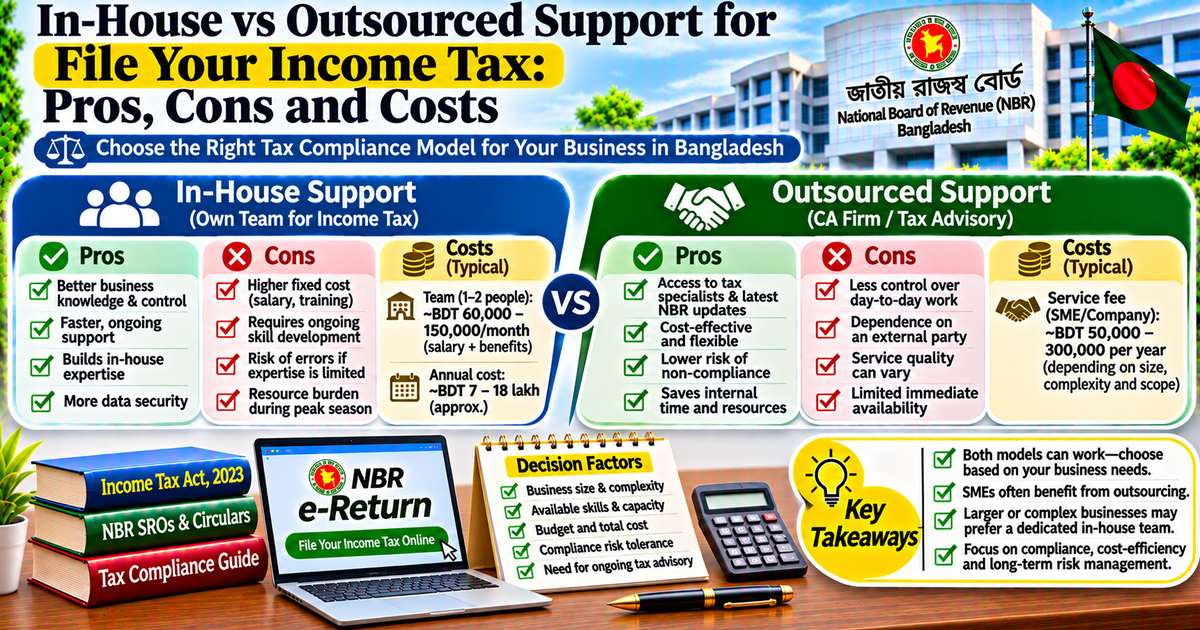
In-House vs Outsourced Support for Filing Your Income Tax: Pros, Cons and Costs in Bangladesh
Introduction
Every business needs a reliable process for preparing and filing its income tax return. However, not every business needs the same level of internal tax expertise.
Some companies prefer to manage tax compliance through their own finance and accounts departments. Others engage Chartered Accountants, tax advisers or specialist consultancy firms to prepare and review their returns. A third group uses a hybrid approach, maintaining internal control while outsourcing specialist tax work.
The decision affects more than the professional fee. It influences compliance quality, management oversight, access to expertise, document security and the company's ability to respond to tax authority queries.
In Bangladesh, businesses must consider their obligations under the Income Tax Act, 2023, as amended, together with applicable rules, Finance Acts and NBR notifications. A company should select a support model that fits its size, transaction complexity, internal capabilities and risk exposure.
This article compares the available options and explains how businesses can assess their costs and responsibilities.
1. What does in-house income tax support mean?
In-house tax support means that the business uses its own employees and internal systems to manage most or all of its income tax preparation.
Depending on the organisation, the work may be handled by:
An accounts officer.
A finance manager.
A tax or compliance officer.
A CFO.
An internal finance and tax team.
The internal team generally collects financial information, reconciles accounts, prepares tax computations, organises supporting documents and coordinates the filing process.
Where specialist advice is needed, the business may still consult an external tax professional.
Advantages of in-house support
1. Direct control over financial information
Employees working within the business have easier access to transaction records, contracts, bank statements, payroll information and management decisions.
This can make it easier to clarify unusual transactions and collect missing documents.
2. Continuous monitoring
An internal team can monitor withholding tax, advance tax, accounting adjustments and other compliance matters throughout the year rather than waiting until the filing season.
3. Institutional knowledge
Employees gradually develop an understanding of the company's accounting policies, business model, transaction patterns and historical tax positions.
4. Greater day-to-day coordination
The finance team can communicate directly with sales, procurement, HR and operations to resolve accounting and documentation issues.
5. Potential long-term cost efficiency
For a business with substantial and recurring tax work, an established internal team may become more economical over time than repeatedly purchasing extensive external services.
Disadvantages of in-house support
1. Salary and employment costs
The company must pay salaries, benefits, training expenses and other employment-related costs. These costs continue even when tax filing activity is relatively low.
2. Limited specialist expertise
A general accountant may not have sufficient experience with complex tax adjustments, transfer pricing, international transactions, tax litigation or specialised statutory requirements.
3. Dependence on key employees
If the only employee familiar with the company's tax affairs resigns or becomes unavailable, the business may face delays and knowledge gaps.
4. Training and regulatory monitoring
Tax legislation changes. Internal employees must keep up with amendments, Finance Acts, rules and NBR notifications.
5. Risk of insufficient independent review
If the same employee prepares, checks and approves the return, important errors may remain undetected.
2. What does outsourced income tax support mean?
Outsourced support means engaging an external professional or firm to perform some or all of the company's tax-related work.
The service provider may be:
A Chartered Accountant or CA firm.
A tax consultancy.
A professional accounting firm.
A qualified tax practitioner.
A specialist corporate tax adviser.
Depending on the engagement, the provider may prepare the tax computation, review financial statements, advise on tax treatment, organise filing documents, assist with submission and support responses to tax authority queries.
The scope should be clearly documented in an engagement letter.
Advantages of outsourced support
1. Access to specialist knowledge
An experienced adviser may have worked with different industries, transaction types and tax issues. This can be valuable when the company faces complex tax questions.
2. Flexibility
Businesses can purchase services according to their needs instead of employing a full-time tax specialist.
3. Independent review
An external adviser may identify weaknesses or inconsistencies that an internal team has overlooked.
4. Access to updated tax knowledge
Established advisers may monitor legislative changes, NBR notifications and relevant tax developments as part of their professional practice.
5. Support for complex transactions
Outsourcing can be particularly useful for companies dealing with cross-border payments, related-party transactions, tax incentives, accumulated losses or significant tax adjustments.
Disadvantages of outsourced support
1. Professional fees
The company must pay for the agreed services. More complex returns, incomplete records and additional advisory work may increase the total cost.
2. Dependence on external timelines
The service provider may be handling several clients at the same time. Delayed document collection or late communication can affect the filing schedule.
3. Less direct access to operational information
An external adviser may not fully understand the commercial background of every transaction unless the company explains it clearly.
4. Confidentiality and data-security risks
The business must share financial and commercial information. Inadequate access controls or weak document-handling practices can expose sensitive data.
5. Scope limitations
A low-cost filing engagement may not include bookkeeping, statutory audit, tax planning, representation or responses to future notices. These services should not be assumed to be included.
3. In-house vs outsourced support: a direct comparison
| Evaluation factor | In-house support | Outsourced support |
|---|---|---|
| Control over daily records | Usually higher | Depends on information provided |
| Access to specialist expertise | Depends on staff capability | Can be higher with a suitable adviser |
| Fixed employment cost | Generally higher | Usually lower for limited engagements |
| Professional service fee | Not normally charged externally | Payable under engagement |
| Business knowledge | Builds internally | Requires onboarding and communication |
| Regulatory updates | Internal responsibility | May be included in agreed services |
| Confidentiality control | Managed through internal systems | Requires provider safeguards |
| Flexibility | Limited by staffing capacity | Can be adjusted by service scope |
| Independent review | Must be arranged internally | Can be part of the engagement |
| Complex tax matters | May require external advice | Specialist support may be available |
Neither model is automatically superior. The appropriate choice depends on the company's resources, transaction complexity and compliance requirements.
4. How much does outsourced income tax support cost in Bangladesh?
There is no single official NBR professional fee for preparing a company's income tax return. The amount paid to an external adviser is a commercial service fee and varies according to the work involved.
Factors affecting the fee include:
Company size and transaction volume.
Quality and completeness of accounting records.
Number of income sources and tax adjustments.
Whether audited financial statements are already available.
Withholding-tax compliance requirements.
Related-party and international transactions.
Tax authority correspondence or previous disputes.
Whether the engagement includes ongoing tax advice.
Published service-provider price examples in Bangladesh illustrate how fees may vary. One provider advertises indicative company-return service ranges from approximately Tk 8,000–20,000 for a small or dormant company, Tk 20,000–50,000 for a small-to-medium trading company and Tk 50,000–1,20,000 for a growing company. These are provider-published commercial examples, not official rates or a market-wide survey. Example of published company tax service pricing.
Indicative cost categories
| Service category | What may affect the cost |
|---|---|
| Basic company return preparation | Volume and quality of records, number of schedules |
| Tax computation and review | Complexity of adjustments and tax positions |
| Bookkeeping and year-end accounts | Number of transactions and accounting condition |
| Statutory audit | Applicable audit scope and professional requirements |
| Withholding-tax compliance | Number and type of transactions and reporting obligations |
| Tax advisory | Complexity of legal and commercial questions |
| Notice or assessment support | Nature of the notice, evidence and work required |
Important: Do not treat the example figures as a quotation. Obtain written proposals from qualified providers and compare the precise services included. Statutory audit fees, bookkeeping, VAT services and tax return preparation may be separately charged.
5. What does in-house support really cost?
An in-house tax function has costs that may not appear as a separate tax filing fee.
For example, a company may need to consider:
Salary and benefits of finance personnel.
Recruitment and onboarding.
Tax and accounting training.
Accounting and document-management software.
Hardware and secure storage.
Time spent by senior management reviewing returns.
External advice for specialised issues.
Employee replacement and knowledge-transfer costs.
A business should calculate the total annual cost rather than comparing an outsourced quotation only with the salary of one employee.
A simple cost comparison
Assume a company is considering two options:
Option A — In-house model
Annual allocated staff cost: Tk 600,000.
Software and training: Tk 60,000.
External specialist review: Tk 40,000.
Estimated annual cost: Tk 700,000.
Option B — Outsourced model
Annual agreed tax and compliance support: Tk 180,000.
Internal coordination and document preparation cost: Tk 60,000.
Estimated annual cost: Tk 240,000.
These figures are hypothetical examples for demonstrating the comparison. They are not quoted market rates. The scope of the services in each option must also be comparable.
6. Which model is suitable for different businesses?
Small businesses and early-stage companies
A small business may not need a dedicated full-time tax employee. A lean internal accounts function combined with outsourced tax preparation and review can be more practical.
The business should still maintain its own books and supporting documents.
Growing SMEs
An SME with increasing transaction volume may benefit from an internal accountant or finance manager supported by an external tax adviser.
This arrangement provides day-to-day control while retaining access to specialist knowledge.
Medium and large companies
Companies with multiple departments, large transaction volumes or complex tax positions may benefit from a dedicated internal tax and finance team.
External specialists can provide independent reviews, technical opinions and support for complex issues.
Foreign-invested and cross-border businesses
Businesses with foreign shareholders, non-resident payments, related-party transactions or transfer-pricing obligations may need specialist tax advice.
The internal finance team should coordinate records and transactions, while the external adviser reviews the relevant statutory and international tax implications.
7. Consider a hybrid model
For many businesses, the most practical solution is neither complete outsourcing nor complete in-house management.
A hybrid model combines internal ownership with external professional support.
The internal team manages:
Daily bookkeeping.
Sales and purchase records.
Bank reconciliations.
Payroll information.
Inventory and fixed asset schedules.
Withholding-tax records.
Document collection.
Management reporting.
The external adviser manages or reviews:
Tax computation.
Complex tax adjustments.
Legal interpretation.
Tax planning within the law.
Return review and filing assistance.
Specialist compliance matters.
Agreed support for tax authority notices.
This model allows the company to retain control over its financial information while using external expertise where it adds value.
8. How to select an outsourced tax service provider
Before appointing an adviser, management should conduct basic due diligence.
Professional capability
Check the provider's qualifications, relevant experience and ability to handle the company's industry and transaction profile.
Scope of work
Ask whether the quotation includes:
Review of accounting records.
Tax computation.
Return preparation.
Submission assistance.
Tax payment calculation.
Withholding-tax review.
Responses to tax notices.
Post-filing support.
Fee transparency
Request a written fee breakdown. Identify additional charges for audit, bookkeeping, advisory work and future representation.
Confidentiality
Confirm how the provider stores, accesses, transfers and protects financial records.
Communication and deadlines
Agree on a document submission timetable, review process, communication channel and escalation procedure.
Responsibility and accountability
The engagement letter should specify who prepares, reviews, verifies and submits the return, as well as the responsibilities of the company and adviser.
9. Legal responsibilities do not disappear when tax work is outsourced
This is an important distinction.
Engaging an external adviser does not automatically transfer every statutory responsibility of the taxpayer to that adviser.
Under section 166 of the Income Tax Act, 2023, companies are among the categories for which return filing is required, subject to the Act's provisions and exceptions. Section 169 sets out the general requirements for furnishing returns and supporting documents. For a company, the return is signed and verified by its principal officer under the applicable provision.
A company should therefore maintain oversight even when an external professional prepares the return. It should verify the figures, provide accurate information, approve the final return and retain the necessary records. Income Tax Act, 2023.
Businesses should also consider section 177, which imposes withholding-tax return obligations on specified entities, including companies, subject to the statutory requirements.
10. A decision checklist for management
Before choosing a model, management should answer these questions:
Does the business have a competent internal finance team?
How many transactions does it process annually?
Are its accounting records complete and reconciled?
Does it have complex tax adjustments or international transactions?
Can the internal team monitor tax law changes?
Does the company need independent professional review?
What is the total annual cost of each option?
What services are included in an outsourced quotation?
How will confidential financial information be protected?
Who will remain accountable for approval and submission?
A written comparison of these factors will provide a more reliable basis for decision-making than choosing the lowest quotation.
Conclusion
In-house and outsourced income tax support offer different advantages. In-house teams provide operational knowledge and continuous control, while external advisers can provide specialist expertise, flexibility and independent review.
For many businesses in Bangladesh, a hybrid model offers a balanced solution: keep bookkeeping, financial records and internal approvals within the company while outsourcing technical tax work when necessary.
The right decision should be based on the company's size, complexity, internal capacity, total cost and compliance risks—not simply on the price of preparing a return.
Legal disclaimer: This article provides general information about business income tax support in Bangladesh. It is not individual legal, accounting or tax advice. The Income Tax Act, 2023, subsequent amendments, applicable rules and NBR notifications should be reviewed for the relevant assessment year.