

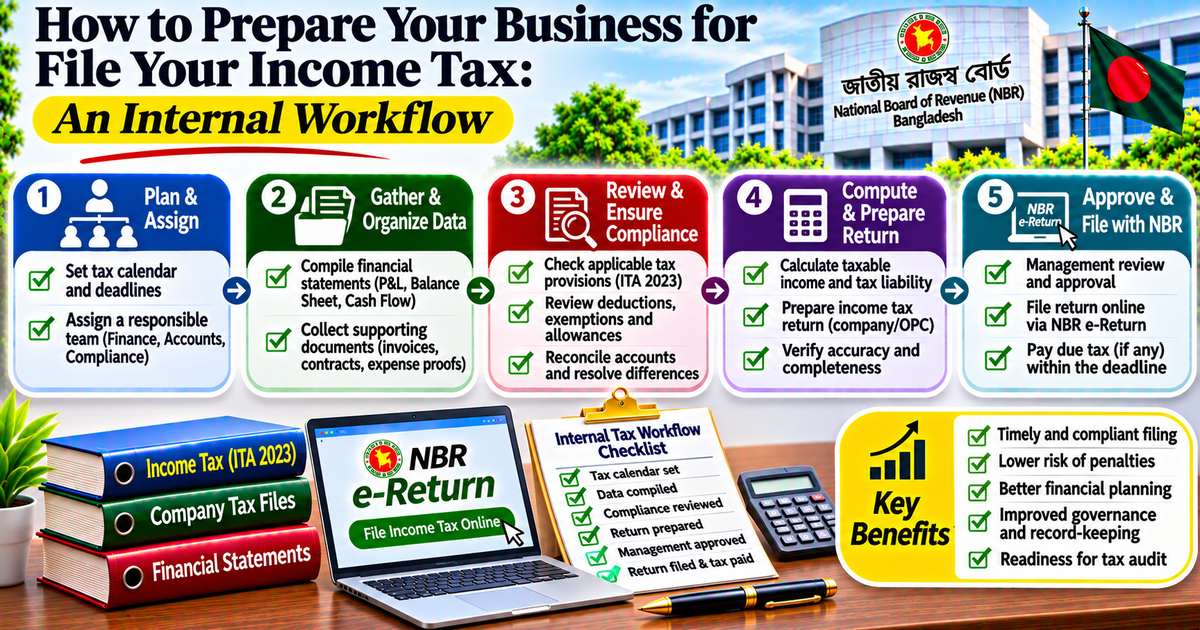
How to Prepare Your Business for Filing Income Tax: An Internal Workflow in Bangladesh
Introduction
For a business, filing an income tax return should be the final stage of an organised compliance process—not an activity that begins a few days before the deadline.
When financial information is incomplete, responsibilities are unclear or supporting documents are scattered across departments, tax preparation becomes difficult. These weaknesses can lead to inaccurate reporting, missed tax credits, unsupported deductions and delays in submission.
An effective internal workflow addresses these problems by establishing clear responsibilities, regular financial reconciliations, reliable document management and formal approval procedures.
In Bangladesh, the Income Tax Act, 2023, together with subsequent amendments, Finance Acts, rules and National Board of Revenue (NBR) notifications, provides the statutory framework for income tax compliance. Businesses should align their internal procedures with the requirements applicable to their legal structure and assessment year.
This guide explains how to design a practical internal workflow for preparing and filing a business income tax return.
1. Establish a tax compliance owner
The first step is to assign clear responsibility for coordinating the filing process.
A company should identify one person or team responsible for managing the tax calendar, collecting information, coordinating departments and communicating with external tax advisers.
Depending on the size of the business, this responsibility may sit with:
Chief Financial Officer (CFO).
Finance manager.
Head of accounts.
Tax or compliance officer.
Company secretary, where relevant.
An appointed external tax adviser working with an internal coordinator.
The company should also appoint a senior management representative to review and approve the final return.
Recommended responsibility structure
| Role | Main responsibility |
|---|---|
| Finance manager | Coordinates the entire tax filing process |
| Accounts team | Maintains ledgers and prepares financial schedules |
| Sales department | Provides sales invoices and revenue reconciliations |
| Procurement team | Provides purchase records and supplier documentation |
| HR department | Provides payroll and employee-related information |
| Operations or inventory team | Confirms stock and operational records |
| Tax adviser | Reviews tax treatment and prepares or checks tax computations |
| CFO or authorised management | Reviews and approves the final filing |
For smaller businesses, one person may perform several functions. However, preparation and final approval should be separated as far as reasonably possible.
2. Create an annual tax compliance calendar
A tax filing workflow needs a timetable. Without one, the finance team may receive important information too late to review it properly.
The calendar should cover the entire process, including monthly bookkeeping, year-end closing, financial statement preparation, tax computation, management approval and submission.
A suggested internal timeline is:
| Stage | Suggested timing | Main activity |
|---|---|---|
| Monthly | Throughout the income year | Maintain accounts and reconcile transactions |
| Quarterly | Every three months | Review tax payments and withholding-tax compliance |
| Pre-year-end | Before the financial year closes | Identify missing documents and outstanding balances |
| Year-end closing | Immediately after year-end | Finalise ledgers and reconcile accounts |
| Financial reporting | After closing | Prepare and audit financial statements where required |
| Tax computation | Before the filing deadline | Calculate taxable income and tax liability |
| Management review | Before submission | Review and approve the return |
| Filing | By the applicable statutory deadline | Submit the return and pay tax due |
| Post-filing | After submission | Archive documents and monitor notices |
These are recommended internal milestones, not statutory deadlines. The company must separately confirm its actual tax day and any extension applicable to the relevant assessment year.
3. Standardise monthly bookkeeping and record collection
A reliable tax return depends on accurate records throughout the year.
The finance department should establish a monthly closing procedure covering:
Sales and revenue recognition.
Purchase and supplier invoices.
Cash and bank transactions.
Payroll and employee benefits.
Rent, utilities and administrative expenses.
Loan balances and interest.
Inventory movements and closing stock.
Fixed asset additions and disposals.
Tax deducted or collected at source.
Advance tax payments and other tax credits.
Each transaction should have appropriate supporting evidence, such as an invoice, receipt, contract, bank statement, payment record or approved voucher.
Practical control
Create a monthly document submission deadline for each department. For example, sales and procurement records can be submitted to accounts within a fixed number of working days after month-end.
The finance manager should maintain a missing-document register and follow up on unresolved items.
4. Maintain a central tax document repository
Businesses should not depend on individual employees’ email accounts, personal computers or informal messaging groups to preserve tax documents.
Instead, maintain a controlled digital repository with folders organised by financial year and transaction category.
A suggested structure is:
Corporate and TIN documents.
Financial statements and audit reports.
General ledger and trial balance.
Sales and revenue records.
Purchase and expense records.
Payroll and employee records.
Bank statements and reconciliations.
Inventory and fixed asset schedules.
Withholding-tax documents.
Advance tax and payment receipts.
Tax computations and working papers.
Filed returns and tax authority correspondence.
Access should be restricted according to job responsibilities. Important files should have version control and secure backups.
Legal provision to review — Section 72A: The Act contains specific requirements for retaining accounts, supporting documents, bills, vouchers and related records. The provision distinguishes the retention period for companies from that applicable to other taxpayers and permits records to be maintained in physical or digital form. Companies should align their retention policy with the Companies Act, 1994 and other applicable requirements. Income Tax Act, 2023, section 72A.
5. Introduce a monthly tax reconciliation process
Bookkeeping and tax compliance should not operate as completely separate activities.
The finance team should periodically reconcile tax-related transactions rather than waiting until the end of the year.
A monthly or quarterly review should cover:
Tax deducted at source on relevant payments.
Tax collected at source, where applicable.
Tax deposits and payment references.
Withholding-tax certificates.
Required withholding-tax returns.
Advance income tax.
Tax-related balances in the general ledger.
This review helps identify missing deductions, incorrect rates, delayed deposits and differences between accounting records and tax records.
The company should maintain a withholding-tax reconciliation schedule showing the transaction, recipient, applicable provision, deduction or collection, deposit date and supporting reference.
Legal provisions to review: The withholding-tax provisions in the Income Tax Act, 2023 and applicable withholding-tax rules should be reviewed according to the nature of each transaction. Section 177 is particularly relevant to returns relating to tax deducted or collected at source by specified persons.
6. Conduct a formal year-end closing
Once the income year ends, the business should complete a structured year-end closing process.
The finance team should verify:
Revenue and expense cut-off.
Outstanding receivables and payables.
Cash and bank balances.
Inventory quantities and valuation.
Fixed asset additions and disposals.
Depreciation and relevant tax adjustments.
Loan balances and accrued interest.
Provisions and reserves.
Related-party balances and transactions.
Unusual or material journal entries.
Any significant adjustment should have a clear explanation and supporting documentation.
Management should require the accounts team to prepare a year-end closing checklist and obtain confirmation from relevant departments before the trial balance is finalised.
7. Prepare financial statements and identify audit requirements
After the accounting records have been reviewed, the business should prepare its financial statements.
Companies must ensure that their accounting and reporting processes comply with applicable financial reporting standards and Bangladesh laws.
The company should determine whether an audit and audited financial statements are required under the relevant provisions and circumstances.
Where an audit is required, the finance team should provide the auditor with a complete set of records, including:
Trial balance.
General ledger.
Bank reconciliations.
Sales and purchase schedules.
Fixed asset register.
Inventory records.
Payroll schedules.
Loan and interest schedules.
Supporting documents for material transactions.
Legal provisions to review — Sections 72 and 73: Section 72 addresses accounting methods and company financial reporting, including the applicable IAS, IFRS and IFRS for SMEs requirements. Section 73 addresses audited financial reporting by specified taxpayers. The company should confirm the applicable requirements rather than assuming that every taxpayer has identical audit obligations.
8. Prepare and independently review the tax computation
Once the financial statements are available, the tax computation should be prepared separately.
The computation should explain how the business moves from accounting profit or loss to taxable income under the applicable tax law.
The tax review should cover:
Income classification.
Allowable and disallowable expenses.
Depreciation and applicable tax allowances.
Provisions and reserves.
Exempt or specially treated income.
Tax losses and eligible adjustments.
Minimum tax and other applicable tax provisions.
Tax deducted or collected at source.
Advance tax and other tax payments.
Final tax payable or refundable amount.
A separate reviewer should verify the calculations and supporting working papers.
The review should not be limited to checking arithmetic. It should also assess whether the tax treatment is supported by the relevant statutory provision and available evidence.
Legal provision to review — Section 169: The return must be furnished in the prescribed form with the schedules, statements, accounts, annexures and documents required by the Board. For taxpayers subject to the relevant audited financial reporting requirements, the return must include the specified audited statements and tax computation documents.
9. Introduce a formal management approval process
A company should not allow the person preparing the return to submit it without an appropriate review and authorisation process.
A practical approval structure can have three stages:
Stage 1 — Preparation
The accounts or tax team prepares the return, supporting schedules and tax computation.
Stage 2 — Technical review
The finance manager, CFO or tax adviser reviews the figures, tax adjustments, supporting evidence and outstanding issues.
Stage 3 — Authorisation
The person authorised under the law verifies and approves the return for submission.
The approval file should record:
Name and designation of the preparer.
Name and designation of the reviewer.
Date of review.
Material issues identified.
Adjustments made.
Outstanding matters, if any.
Final approval and submission authority.
Legal provision to review — Section 169: This section sets out general return-filing requirements, including the prescribed form and verification requirements. For a company, particular attention should be given to the person legally authorised to sign and verify the return.
10. Submit the return and complete payment reconciliation
After approval, the responsible person should submit the return using the applicable filing procedure.
The company should:
Confirm the correct taxpayer and assessment year.
Check that the prescribed form and schedules are complete.
Verify the final tax computation.
Confirm tax credits and payments.
Pay the balance tax due within the applicable statutory timeline.
Submit the return through the applicable channel.
Save the acknowledgement and final submitted copy.
The NBR's official e-Return portal provides electronic tax services. However, businesses should verify the filing method applicable to their taxpayer category rather than assuming that individual e-Return instructions automatically apply to companies.
Legal provisions to review — Sections 170, 170A, 171, 173 and 174: These provisions address return deadlines, filing procedures, tax payment and late filing. The company should check the current statutory text and applicable NBR notifications for the relevant assessment year.
11. Establish a post-filing monitoring procedure
The workflow should continue after submission.
The finance team should maintain a post-filing register containing:
Date of submission.
Assessment year.
Tax paid.
Acknowledgement reference.
Copies of the submitted return.
Supporting documents.
Tax authority notices or requests.
Response deadlines.
Status of any assessment or audit.
If the tax authority requests information, the company should identify the responsible officer, retrieve the relevant documents and respond within the specified period.
Legal provisions to review — Sections 176, 179 and 182: These provisions address incomplete returns, production of accounts and documents, and audit selection. A filing acknowledgement should not be treated as a guarantee that the return will not be examined further.
12. Measure the effectiveness of the internal workflow
Management should periodically assess whether the tax process is working effectively.
Useful internal performance indicators include:
| KPI | What it measures |
|---|---|
| On-time document submission rate | Whether departments provide information within the agreed timeline |
| Reconciliation completion rate | Whether key accounts and tax balances are reconciled |
| Missing-document count | Number of unresolved supporting-document gaps |
| Tax adjustment resolution rate | Whether identified tax issues are resolved before filing |
| Review completion rate | Whether the required approvals are documented |
| On-time filing rate | Whether returns are submitted by the applicable deadline |
| Post-filing response time | How quickly the business responds to tax authority requests |
These indicators can be included in the company’s monthly or quarterly finance and compliance reports.
A practical internal income tax workflow
The following sequence can be adopted as a standard operating procedure:
Assign a tax compliance owner.
Prepare the annual tax calendar.
Collect and record financial information monthly.
Reconcile withholding tax and tax payments.
Complete year-end closing.
Prepare financial statements and arrange audit where required.
Calculate taxable income and final tax liability.
Conduct an independent technical review.
Obtain management authorisation.
Submit the return and pay tax due.
Archive records and monitor post-filing matters.
Conclusion
A well-designed internal income tax workflow reduces last-minute pressure and improves the quality of corporate tax compliance. It also creates accountability by defining who collects information, who prepares the computation, who reviews the return and who authorises submission.
Businesses should treat tax filing as a year-round governance responsibility. Regular bookkeeping, centralised document management, tax reconciliation and management review make the final filing process more controlled and defensible.
The key provisions to review include sections 72, 72A, 73, 169, 170, 170A, 171, 173, 174, 176, 177, 179 and 182 of the Income Tax Act, 2023, together with subsequent amendments and applicable NBR rules.
Legal disclaimer: This article provides general information about business tax compliance in Bangladesh. It does not constitute legal, accounting or tax advice for a particular taxpayer. Businesses should verify the applicable law, filing method, deadlines and documentary requirements for their specific circumstances and assessment year.