

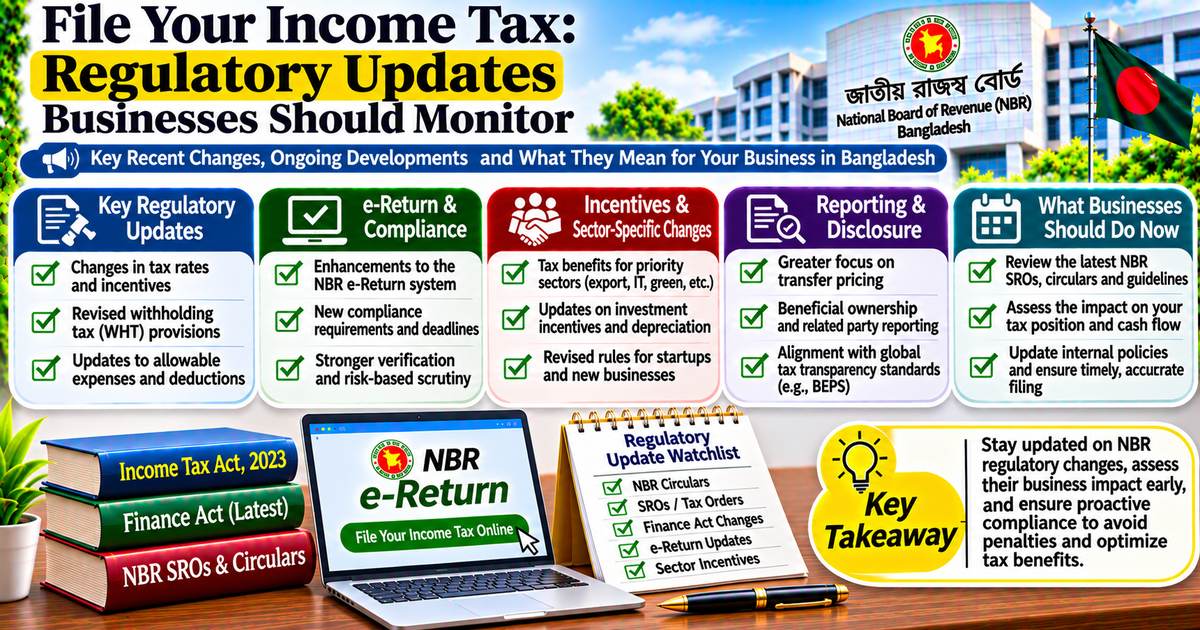
File Your Income Tax: Regulatory Updates Businesses Should Monitor in Bangladesh Introduction
Tax regulations in Bangladesh can change through annual Finance Acts, amendments to the Income Tax Act, rules, statutory regulatory orders (SROs), general orders and NBR notifications.
For businesses, these changes can affect corporate tax rates, taxable income, deductions, withholding tax, filing deadlines, tax payments and reporting procedures.
A company that relies only on previous-year tax guidance may overlook an important change. This can result in incorrect tax calculations, missed deadlines or unnecessary compliance risks.
This guide highlights the regulatory areas businesses should monitor when preparing their income tax returns in Bangladesh.
1. Monitor Amendments to the Income Tax Act, 2023
The Income Tax Act, 2023 is the principal legislation governing income tax in Bangladesh.
However, businesses should not rely exclusively on the original version of the Act. Subsequent Finance Acts and other valid amendments may change its provisions.
A significant development is the Finance Act, 2026 (Act No. XCVI of 2026), which received presidential assent on 30 June 2026 and amended several fiscal laws, including the Income Tax Act, 2023.
Businesses should review amendments relating to:
Corporate income tax.
Taxable income calculations.
Allowable and disallowable expenses.
Minimum tax provisions.
Tax deducted or collected at source.
Return submission requirements.
Assessment and appeal procedures.
Tax exemptions and incentives.
Practical action: Maintain an updated copy of the Income Tax Act, 2023, together with the amendments applicable to the relevant assessment year.
The NBR's official website provides access to the Finance Acts and income tax legislation.
2. Review Changes to Corporate Tax Rates
Corporate tax rates can change according to the company's category and the applicable assessment year.
Businesses should verify:
Whether the company is publicly traded or privately held.
Whether it belongs to a specially regulated industry.
Whether a special tax rate applies.
Whether a reduced rate depends on specific conditions.
Whether the company satisfies the conditions for any applicable tax benefit.
For example, the published corporate tax rate framework for assessment years 2026–2027 and 2027–2028 identifies different rates for ordinary companies, listed companies and financial institutions. The relevant budget-year provisions also address conditional rates linked to banking transactions.
Do not assume that a rate applicable to one company category automatically applies to another.
Practical action: Before calculating taxable income, confirm the latest enacted rate schedule and retain evidence that the company satisfies any conditions attached to a reduced rate.
3. Monitor the Withholding Tax Rules, 2026
Withholding tax is one of the most important regulatory areas for businesses to monitor.
NBR published the Withholding Tax Rules, 2026 on 12 June 2026 and subsequently published an amendment on 6 July 2026.
These developments mean that businesses should review their existing withholding procedures rather than automatically continuing to use previous-year rates and practices.
Pay particular attention to payments involving:
Suppliers and contractors.
Office rent.
Professional and consultancy services.
Salaries and employee payments.
Commission.
Interest.
Imports and specified transactions.
Non-resident service providers.
For each transaction, the finance team should verify the applicable deduction or collection requirement, rate, calculation basis, deposit deadline and documentation.
Practical action: Update the accounting system's withholding tax schedules and review supplier payment procedures against the current rules.
4. Watch for Changes to Corporate Return Filing Deadlines
Return deadlines are among the most important regulatory matters for companies.
The Finance Act, 2026 changed the statutory timetable for company returns under the Income Tax Act, 2023.
For companies and other relevant non-individual taxpayers, the general filing date is now the 15th day of the ninth month following the end of the income year, subject to a minimum date of 15 September where the ninth-month date falls earlier.
For a company with a normal 1 July–30 June income year, this generally means 15 March of the following year.
However, companies with different accounting periods may have a different statutory date. Any valid NBR extension should also be checked separately.
Businesses should not assume that an extension granted in one year automatically applies to the next year.
Practical action: Create a company-specific tax calendar using its actual income-year end and monitor official NBR deadline notifications.
5. Follow the NBR Income Tax Guide and Paripatra
The NBR publishes income tax guidance to help taxpayers understand the law and its practical application.
For the 2026–2027 period, NBR published its Income Tax Guide on 24 September 2026.
Businesses should review the current guidance for:
Tax calculations.
Applicable rates.
Deductions and exemptions.
Tax payment procedures.
Return preparation.
Tax credits.
Relevant compliance requirements.
The annual Income Tax Paripatra is also important because it provides explanations and administrative guidance concerning the applicable tax provisions.
A business should use guidance for the correct assessment year and verify important legal interpretations against the enacted legislation.
6. Monitor Minimum Tax and Special Tax Treatment
Businesses should review changes affecting minimum tax and other special tax provisions.
A company may have low accounting profit or report a business loss, but this does not automatically mean that it has no income tax liability.
Depending on its business category and the applicable provisions, minimum tax may be calculated using a statutory basis other than ordinary taxable profit.
Businesses should monitor:
Changes to minimum tax provisions.
Treatment of gross receipts.
Special business income.
Tax on specified income.
Special tax rates.
Applicable exemptions.
Practical action: Ask the tax team to review minimum tax exposure separately from the ordinary tax computation.
7. Review Tax Deduction and Disallowance Rules
The treatment of business expenses can change through amendments or administrative clarification.
Businesses should monitor rules relating to:
Salary and employee benefits.
Rent and property-related expenses.
Professional fees.
Advertising and marketing.
Interest expenses.
Depreciation.
Provisions and reserves.
Donations and contributions.
Bad debts.
Related-party expenses.
A business should not automatically treat every accounting expense as tax-deductible.
For each significant expense category, confirm whether the applicable law permits deduction and whether specific documentation or payment conditions must be satisfied.
Practical action: Update the tax computation template whenever an amendment changes the treatment of a major expense category.
8. Monitor Tax Incentives and Exemption Notifications
Tax incentives can influence investment decisions and the effective tax burden of a business.
NBR may issue notifications or SROs providing tax exemptions or special treatment for specified industries, activities or investments.
For example, its 2026 updates included notifications concerning tax exemption for certain edible-oil manufacturing activities and electricity generated from renewable solar energy sources.
However, these notifications apply according to their specific conditions. They should not be treated as general exemptions for every business operating in those sectors.
Before claiming a benefit, review:
The legal notification or SRO.
Eligible business activities.
Effective and expiry dates.
Required approvals.
Investment or operational conditions.
Documentation and reporting requirements.
Practical action: Maintain a separate tax incentive register showing the legal basis, eligibility conditions and validity period of every claimed benefit.
9. Keep Track of Changes to Tax Refunds and Adjustments
A company may have paid more tax than its final calculated liability because of advance payments, withholding tax or other eligible credits.
The Finance Act, 2026 introduced amendments relevant to the treatment of excess tax deducted, collected or deposited, including refund or adjustment provisions subject to statutory requirements.
Businesses should therefore review:
Eligible tax credits.
Excess withholding tax.
Advance tax payments.
Refund claims.
Adjustments against previous or subsequent years' liabilities.
Supporting challans and certificates.
A company should not assume that an excess payment will automatically be refunded without following the applicable procedure.
Practical action: Reconcile tax credits before filing and maintain a documented schedule of excess payments and any refund or adjustment claims.
10. Monitor Changes to Tax Appeals and Dispute Procedures
Tax disputes can affect a company's financial position and management decisions.
Businesses should monitor amendments relating to:
Assessment orders.
Appeals before the Commissioner of Taxes (Appeals).
Appeals before the Taxes Appellate Tribunal.
Pre-deposit requirements.
Payment of admitted tax.
Refund claims.
Time limits for filing appeals.
The Finance Act, 2026 also amended aspects of the tax dispute framework, including pre-deposit requirements for specified appeals.
A company facing an assessment dispute should examine the current statutory procedure before deciding whether to challenge the order.
Practical action: Record all assessment orders, notices and appeal deadlines in a centralised compliance register.
11. Monitor Digital Tax Services and Filing Procedures
NBR continues to maintain digital services for tax-related activities.
Businesses should monitor relevant developments involving:
e-TIN services.
Income tax e-filing.
e-TDS.
Online tax payments.
Return verification.
Electronic certificates.
Taxpayer support services.
The NBR's online individual e-Return arrangements should not automatically be assumed to be the same as the filing process applicable to companies.
Companies should verify the appropriate filing procedure, forms and authorised verification requirements for their taxpayer category.
Practical action: Assign a responsible person to monitor official NBR announcements about digital filing procedures and system changes.
12. Monitor Transfer Pricing and International Tax Developments
Businesses with foreign shareholders, overseas group companies or cross-border transactions should pay particular attention to international tax rules.
Relevant areas include:
Transfer pricing.
Related-party transactions.
Payments to non-residents.
Double taxation agreements.
Permanent establishment issues.
Tax treatment of royalties and service fees.
Foreign tax credits.
Supporting documentation and reporting.
The tax treatment of a payment to a foreign entity depends on the nature of the payment, the recipient's status, domestic law and any applicable treaty.
A business should not apply one withholding tax rate to every overseas payment.
Practical action: Review international transactions before payment and retain contracts, invoices, tax residency documents and relevant transfer pricing records.
13. Do Not Confuse Income Tax Updates with VAT Changes
Businesses often monitor tax regulations as a single subject. However, income tax and VAT are separate legal systems.
A VAT amendment does not automatically change the income tax treatment of a transaction.
Businesses should separately monitor:
| Income tax matters | VAT matters |
|---|---|
| Corporate tax rates | VAT rates |
| Taxable income | Taxable supplies |
| Deductible expenses | Input tax credit |
| Withholding tax | VAT deduction at source |
| Income tax returns | VAT returns |
| Advance income tax | VAT payments and adjustments |
A company should also check whether a change in one tax system creates a record-keeping or reconciliation requirement in the other.
14. Practical Regulatory Monitoring Checklist for Businesses
Businesses can use the following checklist to monitor tax developments throughout the year.
| Regulatory area | What to monitor | Suggested action |
|---|---|---|
| Income Tax Act | New amendments | Update tax policies |
| Finance Act | Annual tax changes | Review tax computation |
| Corporate tax rates | Rate changes and conditions | Verify company category |
| Withholding Tax Rules | New rates and amendments | Update payment controls |
| Filing deadlines | Statutory dates and extensions | Update compliance calendar |
| Income Tax Paripatra | Annual guidance | Review tax treatment |
| Tax incentives | New SROs and notifications | Check eligibility |
| Minimum tax | Changes to statutory calculation | Reassess tax exposure |
| Tax appeals | Procedural changes | Review dispute strategy |
| Digital services | Filing and payment updates | Update internal procedures |
| Transfer pricing | Documentation and reporting | Review related-party transactions |
| VAT legislation | Separate VAT changes | Reconcile tax records |
15. How to Build an Effective Tax Regulatory Monitoring System
Businesses should not depend on occasional internet searches or informal messages to identify regulatory changes.
A better approach is to establish a simple monitoring process.
Monthly review
Check new NBR notifications and SROs.
Review withholding tax updates.
Confirm tax deposits and reporting deadlines.
Identify transactions affected by regulatory changes.
Quarterly review
Review corporate tax exposure.
Update the tax risk register.
Check related-party transactions.
Discuss important changes with management or a tax adviser.
Annual review
Review the Finance Act.
Update the company's tax computation model.
Confirm applicable tax rates and filing deadlines.
Review the annual Income Tax Guide and Paripatra.
Update tax policies and staff responsibilities.
The process should be proportionate to the size and complexity of the business.
Conclusion
Regulatory monitoring is an essential part of responsible income tax compliance in Bangladesh. Changes to the Finance Act, Income Tax Act, withholding tax rules, filing procedures and tax incentives can directly affect a company's financial and legal responsibilities.
Businesses should monitor official updates throughout the year rather than waiting until the annual filing deadline.
A structured regulatory monitoring process helps companies identify changes early, update their accounting procedures and prepare more accurate income tax returns.
Legal disclaimer: This article provides general information about Bangladesh tax regulation and is not a substitute for professional legal or tax advice. Regulatory requirements, rates and deadlines should be verified against the legislation, amendments and NBR notifications applicable to the relevant assessment year.