

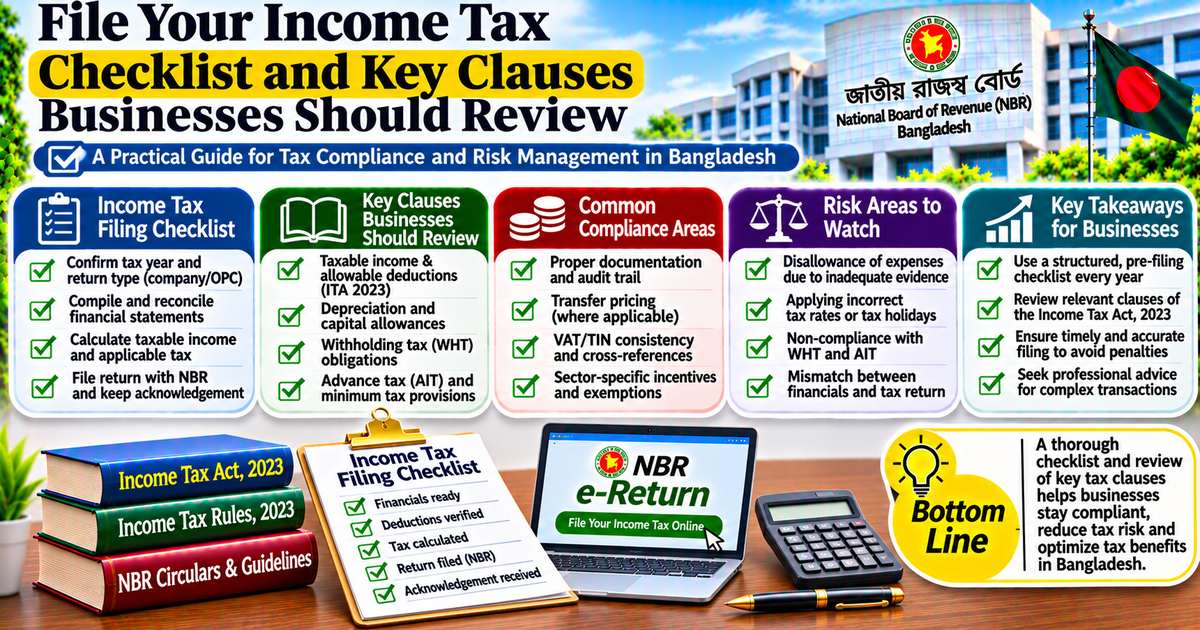
File Your Income Tax: Checklist and Key Clauses Businesses Should Review in Bangladesh
Introduction
Filing an income tax return is not simply a matter of completing a form and submitting a set of financial figures. For a company operating in Bangladesh, the process requires a careful review of its accounting records, taxable income, supporting documents, withholding-tax compliance and statutory obligations.
An error in the return may create questions during assessment, require additional explanations or expose the company to further tax consequences. Incomplete supporting information can also create problems even where the return has been submitted and an acknowledgement has been received.
The principal legislation is the Income Tax Act, 2023, read with subsequent amendments, Finance Acts, applicable rules and National Board of Revenue (NBR) notifications. Businesses should therefore review both their financial information and the legal requirements applicable to the relevant assessment year. NBR’s official Acts index provides access to the published legislation and amendments.
This guide sets out a practical checklist and explains the key statutory provisions businesses should review before filing.
1. Confirm the taxpayer’s legal identity and filing obligation
The first step is to establish exactly who is filing the return.
A private limited company, partnership firm and sole proprietorship do not necessarily have identical filing obligations. In particular, a company is a separate taxpayer from its shareholders and directors. A sole proprietorship, by contrast, is generally assessed through the proprietor’s individual tax affairs.
Before preparing the return, verify:
The registered legal name and taxpayer identification number (TIN).
The taxpayer’s legal structure and registration details.
The applicable income year and assessment year.
The registered address and relevant tax jurisdiction.
Whether the business is required to file an income tax return.
Whether any previous assessment, notice or tax proceeding affects the current filing.
Legal provision to review — Section 166: This section sets out the circumstances in which a person is required to file a return. Businesses should assess their filing obligation under the current law rather than relying solely on turnover, profitability or a previous year’s filing practice.
2. Reconcile the accounting records before preparing the return
A reliable tax return starts with reliable financial records. Management should ensure that the accounting records reflect the actual business transactions for the relevant income year.
Review the following:
General ledger and trial balance.
Sales and purchase registers.
Cashbook and bankbook.
Bank statements and bank reconciliations.
Accounts receivable and payable.
Inventory records and stock valuation.
Fixed asset register and depreciation schedules.
Loan balances, interest expenses and repayment records.
Payroll, employee benefits and other staff costs.
Expense vouchers, invoices and supporting contracts.
Particular attention should be given to transactions recorded near the end of the income year. Unrecorded sales, duplicate expenses, incorrect cut-off entries and unsupported journal adjustments can distort the financial statements.
Companies should also confirm that their accounting policies and financial reporting comply with applicable standards and Bangladesh laws.
Legal provision to review — Section 72: The Act addresses methods of accounting and requires companies to maintain accounts and prepare financial reports in accordance with International Accounting Standards (IAS), International Financial Reporting Standards (IFRS) and relevant laws in force in Bangladesh. Income Tax Act, 2023, section 72.
3. Review audited financial statements and audit requirements
Companies should not treat the preparation of financial statements and the preparation of a tax return as interchangeable tasks.
The financial statements show the accounting performance and financial position of the business. The tax return must reflect income computed under the applicable tax legislation.
Before filing, check:
Whether the financial statements have been finalised.
Whether the applicable audit requirement has been met.
Whether the auditor’s report and relevant certificates are complete.
Whether the financial statements are internally consistent.
Whether the statements submitted with the return match the approved final version.
Whether the relevant directors or authorised officers have completed the required approvals and signatures.
Key legal clauses — Sections 72, 73 and 169:
Section 73 addresses the filing of audited financial reports by specified taxpayers. It requires the relevant income statement and financial statements to be certified by a Chartered Accountant in accordance with the statutory conditions. Section 169 sets out the documents that must accompany a return, including audited financial statements and other prescribed information where applicable.
The precise scope of the audit and filing requirements should be checked against the taxpayer’s legal status and any applicable statutory exceptions. Income Tax Act, 2023, sections 72–73 and 169.
4. Prepare a separate tax computation
One of the most important pre-filing exercises is reconciling accounting profit with taxable income.
Accounting profit is not automatically the amount on which income tax is calculated. Some expenses may be disallowed or restricted for tax purposes, while certain receipts may receive different tax treatment under the Act.
Prepare a tax computation that clearly identifies:
Accounting profit or loss before tax.
Add-backs for expenses not allowable under tax law.
Adjustments for depreciation and applicable capital allowances.
Tax treatment of provisions and reserves.
Treatment of exempt or specially treated income, where applicable.
Taxable income under the relevant heads.
Applicable tax rate and any relevant minimum-tax provisions.
Tax deducted or collected at source.
Advance tax payments.
Final tax payable or refundable, as applicable.
For every material adjustment, retain a working paper explaining the legal basis and supporting calculation.
Key legal clause — Section 169: For a company or a person deriving income from long-term contracts, the return must include the prescribed documents, including a separate computation sheet explaining the difference between the profit and loss shown in the financial statements and the income shown in the return. Section 169, Income Tax Act, 2023.
5. Verify withholding-tax compliance
Withholding tax is an important area of corporate tax risk. A business may have obligations to deduct or collect tax at source when making specified payments or receiving specified amounts.
Review transactions such as:
Payments to suppliers and contractors.
Rent and property-related payments.
Professional and consultancy fees.
Salary and employment-related payments.
Commission and service payments.
Interest and other specified financial payments.
Payments to non-residents.
Transactions involving import, export or other specially regulated categories.
For each relevant transaction, check:
Whether tax deduction or collection was required.
Whether the correct statutory rate and calculation basis were applied.
Whether the tax was deposited within the required time.
Whether certificates and supporting documents were issued or received.
Whether the relevant withholding-tax returns and statements were filed.
Whether the accounting records agree with the withholding-tax records.
Do not apply one general withholding-tax rate to every supplier, service provider or non-resident. The applicable rate and conditions depend on the transaction, recipient and relevant statutory provisions.
Key legal clause — Section 177: The Act requires specified entities, including companies and firms, to file returns relating to tax deducted or collected at source, subject to the statutory scope and exceptions. Businesses should also review the relevant provisions of Part 7 and the applicable withholding-tax rules. Section 177, Income Tax Act, 2023.
6. Check tax payments, advance tax and tax deducted at source
Before filing, prepare a reconciliation of the company’s tax payments.
The reconciliation should include:
Advance income tax paid during the income year.
Tax deducted or collected at source.
Tax paid through treasury challans or approved electronic payment channels.
Any tax paid against earlier demands, where relevant.
Outstanding tax liabilities.
The balance tax payable with the return.
Verify the payment references, dates and amounts against the relevant receipts and accounting records. Do not assume that a payment has been credited correctly merely because it appears in the company’s ledger.
Key legal clauses — Sections 171, 173 and 174: Section 171 deals with filing and payment timing. Section 173 addresses payment of tax on or before the filing date, while section 174 provides the statutory method for determining tax where a return is filed after the tax day. The late-filing calculation is not simply a fixed flat penalty; it follows the statutory formula and relevant conditions. Income Tax Act, 2023, sections 171 and 173–174.
7. Review the documents to be submitted with the return
The exact documents depend on the taxpayer’s category, income sources and applicable requirements. A company should generally organise a filing pack containing the following:
| Document or record | Why it matters |
|---|---|
| TIN and company identification details | Confirms the taxpayer’s identity |
| Audited financial statements, where required | Supports the company’s financial position and results |
| Tax computation | Explains accounting-to-tax adjustments |
| Trial balance and relevant schedules | Supports financial statement figures |
| Fixed asset and depreciation schedules | Supports asset and tax depreciation calculations |
| Bank statements and reconciliations | Supports cash and bank balances |
| Sales and purchase summaries | Supports business income and expenses |
| Withholding-tax records | Supports deductions, collections and related compliance |
| Advance tax and payment receipts | Supports tax credits and payments |
| Supporting invoices and contracts | Evidences material transactions |
| Previous return and assessment records | Helps identify opening balances and unresolved matters |
The table is a practical preparation list, not a statement that every item must be uploaded with every return. The prescribed form, statutory provisions and NBR directions determine the documents that must actually accompany the filing.
8. Confirm the return is complete and properly authorised
A return should be reviewed by someone with sufficient knowledge of the company’s financial and tax affairs before submission.
Check that:
The correct return form has been selected.
All required schedules and statements have been completed.
Figures agree with the final financial statements and tax computation.
Supporting documents are consistent with the declared information.
The return has been signed and verified by the person authorised under the law.
The company has retained a complete copy of the submitted return and supporting records.
Key legal clause — Section 169: The Act specifies how returns are to be furnished and verified. For a company, the return is signed and verified by its principal officer under the relevant statutory provision.
Key legal clause — Section 176: An incomplete return may result in a notice requiring the taxpayer to provide missing information, verification, statements or documents. If the taxpayer does not comply with the notice, the return may be treated as void or invalid in specified circumstances, or may be selected for audit. Importantly, an acknowledgement of receipt alone does not establish that the return is complete. Sections 169 and 176, Income Tax Act, 2023.
9. Understand the records that may be requested after filing
Filing the return does not mean the company will never be asked to provide further information.
The tax authority may require relevant accounts, statements, documents, data or electronic records for assessment or audit in accordance with the Act.
Businesses should therefore maintain an organised archive of:
Original invoices and receipts.
Accounting ledgers and financial statements.
Contracts and payment evidence.
Bank records.
Tax computation workpapers.
Withholding-tax documents.
Filed returns and acknowledgement receipts.
Correspondence with the tax authority.
Key legal clauses — Sections 179 and 182: Section 179 deals with the production of accounts and documents when required by the tax authority. Section 182 provides for the selection of returns for audit under the statutory process. Income Tax Act, 2023, sections 179 and 182.
10. Use this final pre-filing checklist
Before authorising submission, management and the tax adviser should complete the following review:
Taxpayer identity, legal structure and TIN verified.
Correct income year and assessment year selected.
Filing obligation and applicable tax day confirmed.
Trial balance and general ledger reviewed.
Bank, cash, inventory and receivable balances reconciled.
Financial statements finalised and audited where required.
Accounting profit reconciled with taxable income.
Tax adjustments supported by working papers.
Withholding-tax deductions, deposits and returns reconciled.
Advance tax and tax deducted at source verified.
Final tax payable or refundable amount reviewed.
Required schedules and supporting documents prepared.
Return signed and verified by the authorised person.
Complete filing pack and proof of submission retained.
Conclusion
A well-prepared income tax return is the result of a structured compliance review, not merely a last-minute filing exercise. Businesses should reconcile their accounts, assess taxable income, verify withholding-tax obligations, confirm payments and ensure that all statutory documents are complete before submission.
The most important legal provisions to review include sections 72, 73, 166, 169, 171, 173, 174, 176, 177, 179 and 182 of the Income Tax Act, 2023, together with subsequent amendments and applicable NBR rules.
For companies with complex transactions, cross-border payments, tax incentives, accumulated losses or significant accounting adjustments, a professional review before filing can help identify issues while there is still time to address them.
Legal disclaimer: This article provides general information on Bangladesh income tax compliance. It is not a substitute for advice based on a company’s specific facts. The applicable law, amendments, rules, NBR notifications and filing requirements should be checked for the relevant assessment year.
Suggested internal links:
Corporate Income Tax Compliance in Bangladesh
Tax Implications of Filing Income Tax for Businesses in Bangladesh
Due Diligence Checklist Before Filing Your Income Tax
Penalties and Consequences of Income Tax Non-Compliance
Official reference: National Board of Revenue — Income Tax Acts and Income Tax Paripatra 2026–2027.