

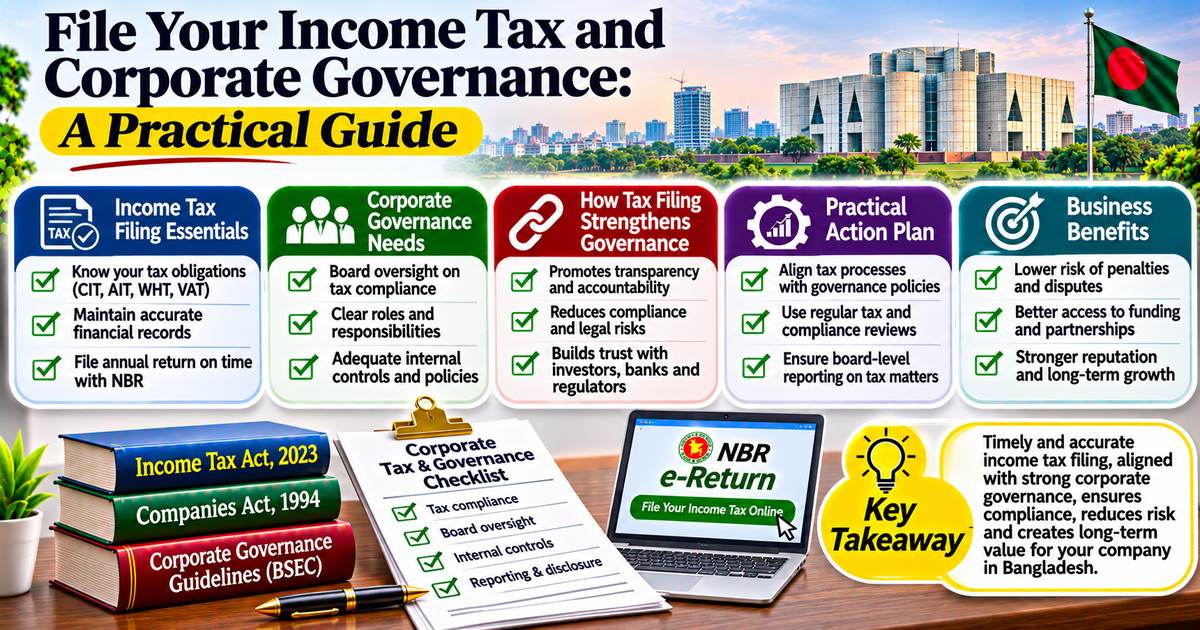
File Your Income Tax and Corporate Governance: A Practical Guide for Businesses in Bangladesh
Introduction
Corporate governance refers to the systems, policies and processes through which a company is directed, controlled and held accountable. It covers the responsibilities of directors, management, shareholders, auditors and other stakeholders.
Income tax compliance is an important part of this framework. A company's tax return communicates its reported income, tax adjustments, tax payments and other relevant information to the tax authority. The process therefore requires reliable financial records, appropriate management oversight and clear accountability.
In Bangladesh, businesses should consider their obligations under the Income Tax Act, 2023, the Companies Act, 1994, applicable financial reporting requirements and, where relevant, Bangladesh Securities and Exchange Commission (BSEC) regulations.
This guide explains how companies can integrate income tax filing into their corporate governance practices.
1. Understanding the Relationship Between Income Tax and Corporate Governance
Income tax filing and corporate governance are closely connected, although they serve different purposes.
Income tax compliance focuses on meeting statutory tax obligations, including reporting taxable income, calculating tax liabilities and submitting required documents.
Corporate governance focuses on ensuring that the company is managed responsibly, decisions are properly authorised and financial information is reliable.
Their relationship can be understood through five governance principles:
Transparency: Financial and tax information should be accurate and adequately supported.
Accountability: Responsible officers should oversee tax compliance and reporting.
Integrity: Income, expenses and tax adjustments should reflect genuine transactions.
Risk management: Potential tax exposures should be identified and addressed.
Compliance: The company should meet applicable tax, company-law and regulatory requirements.
A company may submit its return on time but still have weak governance if the return contains unsupported figures or was prepared without proper review.
2. The Board of Directors Should Oversee Tax Compliance
The board of directors plays an important oversight role in corporate governance.
Although the preparation and submission of a tax return may be delegated to finance personnel or external advisers, the company should maintain appropriate management oversight.
The board or its authorised committee should consider:
Whether the company has a functioning tax compliance process.
Whether financial statements are reliable and properly reviewed.
Whether significant tax risks have been identified.
Whether tax payments and withholding obligations are monitored.
Whether material tax disputes or notices are reported to management.
Whether the company has adequate internal controls.
Whether professional assistance is required for complex tax matters.
The board does not necessarily need to prepare or personally calculate the return. Its responsibility is to ensure that appropriate systems, supervision and accountability exist.
3. Accurate Financial Reporting Is the Foundation of Tax Governance
A reliable income tax return starts with accurate accounting records.
Section 72 of the Income Tax Act, 2023 addresses the method of accounting, while section 72(4) requires companies to maintain accounts and prepare financial reports in accordance with International Accounting Standards (IAS), International Financial Reporting Standards (IFRS) and relevant laws in force in Bangladesh. <Cite refs={["turn342719view1"]}/>
A company should therefore maintain:
General ledger and trial balance.
Sales and purchase records.
Bank statements and reconciliations.
Accounts receivable and payable schedules.
Inventory records.
Fixed asset register.
Payroll and employee benefit records.
Loan and interest schedules.
Related-party transaction records.
Supporting invoices, contracts and payment evidence.
Management should ensure that financial statements are based on complete and verifiable records.
Where the accounting profit differs from taxable income, the company should prepare a separate tax computation explaining the adjustments.
4. Audit and Independent Review Strengthen Accountability
An independent audit can improve the reliability of a company's financial information and support better governance.
The applicable audit requirements depend on the company's legal status and relevant legislation.
Section 73 of the Income Tax Act, 2023 addresses the filing of audited financial reports by specified taxpayers. It requires the relevant financial statements to be certified by a Chartered Accountant in accordance with the statutory requirements, subject to the stated exceptions. <Cite refs={["turn342719view1"]}/>
The company should ensure that:
The appointed auditor is appropriately qualified and independent.
Financial statements are prepared using applicable standards.
Audit findings are communicated to the appropriate level of management.
Material weaknesses are addressed.
Tax adjustments are supported by documented calculations.
Management representations are accurate and complete.
An audit does not guarantee that every tax position is correct. It is one element of a broader governance and assurance framework.
5. Internal Controls Should Cover Tax Reporting and Payments
Internal controls help prevent errors, unauthorised transactions and financial misreporting.
A company should establish clear procedures for:
Income recording
Reconcile sales records with invoices, bank receipts and other supporting documents.
Review revenue recognition and unusual transactions.
Investigate unexplained differences.
Expense approval
Require appropriate approval for business expenses.
Verify invoices and payment evidence.
Distinguish capital expenditure from revenue expenditure.
Identify personal or unsupported expenses.
Tax calculations
Prepare a documented tax computation.
Review tax deductions and disallowances.
Verify the applicable tax rate and minimum tax treatment.
Reconcile tax credits with payment evidence.
Withholding tax
Identify transactions requiring deduction or collection.
Verify the applicable rates.
Monitor deposit deadlines.
Reconcile withholding tax records and certificates.
Return submission
Require an authorised review before submission.
Maintain evidence of approval.
Retain the final return and acknowledgement.
These controls should be proportionate to the size and complexity of the business.
6. Separate Tax Preparation, Review and Approval Responsibilities
One person performing every tax-related task can increase the risk of mistakes or unauthorised changes.
Where resources permit, responsibilities should be separated.
| Responsibility | Suggested role |
|---|---|
| Recording transactions | Accounts team |
| Preparing financial statements | Finance department |
| Preparing tax computation | Tax or finance team |
| Reviewing tax adjustments | Finance controller or tax adviser |
| Approving material tax positions | Authorised senior management or board, as appropriate |
| Authorising return verification | Legally responsible person |
| Independent assurance | External auditor, where applicable |
For a small business with limited staff, full separation may not be practical. In that situation, the owner or director should perform a documented secondary review.
The important principle is that the person preparing the return should not be the only person checking its accuracy.
7. The Company Must Maintain Proper Documentation
Good corporate governance depends on evidence.
The company should maintain a centralised and organised tax compliance file containing:
Previous income tax returns.
Current tax computation.
Audited financial statements, where required.
Tax payment challans and electronic payment evidence.
Withholding tax statements and certificates.
Expense schedules.
Fixed asset and depreciation schedules.
Related-party transaction documents.
Tax exemption or incentive approvals.
NBR notices and correspondence.
Management approval records.
Return submission acknowledgement.
Section 179 of the Income Tax Act, 2023 empowers the tax authority, subject to the statutory requirements, to request accounts, statements, documents, data or electronic records for assessment or audit purposes. <Cite refs={["turn342719view1"]}/>
A company should therefore maintain records that are complete, accessible and capable of supporting the figures reported in its return.
8. Tax Risk Management Should Be Part of Board-Level Oversight
Tax risks can arise from routine business activities as well as complex transactions.
Examples include:
Incorrect classification of income.
Unsupported business expenses.
Failure to deduct or deposit tax at source.
Incorrect tax credits.
Unverified tax incentives.
Unrecorded related-party transactions.
Incorrect depreciation calculations.
Failure to comply with statutory notices.
Differences between accounting and tax records.
A company should maintain a tax risk register for material exposures.
| Tax risk | Possible governance response |
|---|---|
| Incorrect revenue reporting | Periodic revenue reconciliation |
| Unsupported expenses | Invoice verification and approval controls |
| TDS non-compliance | Transaction-based withholding review |
| Incorrect tax credits | Reconciliation with payment evidence |
| Related-party transaction risk | Documented review and transfer pricing assessment |
| Tax notices or disputes | Centralised correspondence and escalation procedure |
| Missed deadlines | Tax compliance calendar and assigned responsibility |
Material tax risks should be escalated to the appropriate management or board committee.
9. Related-Party Transactions Require Transparency
Transactions between a company and its directors, shareholders, associated companies or other related parties should be properly documented.
Examples include:
Loans from directors.
Payments to group companies.
Management fees.
Shared administrative expenses.
Intercompany sales and purchases.
Cross-border transactions.
The company should maintain agreements, invoices, payment records and appropriate approvals.
Where transfer pricing provisions apply, the company should review the relevant reporting, documentation and arm's-length requirements.
Related-party transactions should not be used to conceal income, shift profits without legal justification or disguise personal expenditure as business expenditure.
10. Income Tax Compliance and Companies Act Obligations Are Separate
An important governance issue is understanding that filing an income tax return does not fulfil every company-law obligation.
A company may have separate responsibilities under the Companies Act, 1994, including annual general meetings, financial statements, statutory audit and filings with the Registrar of Joint Stock Companies and Firms (RJSC).
For example, the RJSC's published filing guidance identifies annual return and financial statement filing requirements for companies, including Schedule X and financial statements within the relevant statutory periods. <Cite refs={["turn577788search3","turn577788search6"]}/>
A company should therefore maintain separate compliance calendars for:
NBR income tax returns and payments.
Withholding tax obligations.
RJSC annual filings.
Annual general meetings.
Statutory audit.
VAT returns and payments.
Other sector-specific regulatory requirements.
Completing one filing should never be treated as proof that all other statutory obligations have been fulfilled.
11. Listed Companies Have Additional Governance Considerations
Companies listed on the stock exchange may be subject to additional corporate governance requirements under BSEC regulations.
The Corporate Governance Code, 2018, as amended, provides governance requirements for companies within its scope. These include provisions relating to board composition, independent directors, audit committees, financial reporting and other governance matters. <Cite refs={["turn335108view0","turn342719view0"]}/>
For a listed company, tax reporting should be coordinated with its wider financial reporting and disclosure framework.
The company should ensure that:
The audit committee receives appropriate financial and audit information.
Material tax exposures are communicated to the relevant oversight body.
Financial disclosures are consistent with underlying records.
Related-party matters are reviewed appropriately.
Management responds to material audit findings.
The BSEC Code should not be assumed to apply identically to every private company. The applicable regulatory framework depends on the company's status and circumstances.
12. Who Should Sign and Verify the Company's Tax Return?
A company should ensure that the return is signed and verified by the person legally authorised to do so.
Section 169(5) of the Income Tax Act, 2023 specifies that, in the case of a company or local authority, the return is signed and verified by its principal officer. <Cite refs={["turn342719view2"]}/>
This makes it important for the company to:
Identify the appropriate principal officer.
Confirm that the person has access to the necessary financial information.
Ensure that the return has been reviewed before verification.
Retain evidence of the final submitted version.
Maintain internal records of the approval process.
A tax adviser may prepare or assist with the return, but this does not remove the need for the legally required verification.
13. Practical Corporate Governance Checklist Before Filing
The following checklist can be used by company directors, finance managers and compliance officers.
| No. | Governance control | Completed |
|---|---|---|
| 1 | Tax filing responsibility assigned | ☐ |
| 2 | Financial records reconciled | ☐ |
| 3 | Financial statements reviewed and audited where required | ☐ |
| 4 | Tax computation prepared and checked | ☐ |
| 5 | Income and expenses verified | ☐ |
| 6 | Withholding tax obligations reconciled | ☐ |
| 7 | Tax credits and payments verified | ☐ |
| 8 | Related-party transactions reviewed | ☐ |
| 9 | Tax risks and outstanding notices identified | ☐ |
| 10 | Management review completed | ☐ |
| 11 | Authorised person identified for verification | ☐ |
| 12 | Return and supporting records retained | ☐ |
| 13 | Separate RJSC, VAT and other filings scheduled | ☐ |
14. Practical Example: How Governance Improves Tax Filing
Consider a private limited company preparing its annual income tax return.
Its accounts team prepares the financial statements and calculates taxable income. During the review, the finance manager identifies that some supplier payments may have required withholding tax deduction.
Instead of submitting the return immediately, the company follows an internal procedure:
The finance team identifies the affected transactions.
Supporting invoices and payment records are collected.
The tax adviser reviews the applicable withholding provisions.
The potential tax exposure is calculated.
Management receives a written report.
Appropriate corrective steps are taken under the applicable law.
The return is reviewed and verified by the authorised person.
This is an example of governance in practice: a potential issue is identified, escalated, documented and addressed before it becomes a larger compliance problem.
15. Building a Long-Term Tax Governance Framework
Companies should avoid treating tax compliance as a once-a-year activity.
A more effective approach includes:
Maintaining monthly accounting reconciliations.
Reviewing withholding tax transactions regularly.
Updating the tax compliance calendar.
Monitoring tax law and regulatory changes.
Conducting periodic internal tax reviews.
Documenting material management decisions.
Training finance personnel.
Reviewing unresolved audit findings.
Reporting significant tax risks to senior management.
A consistent process makes annual filing more efficient and reduces the risk of discovering major problems at the last moment.
Conclusion
Income tax filing is an important component of corporate governance because it reflects the quality of a company's financial reporting, internal controls, management oversight and statutory compliance.
For businesses in Bangladesh, good tax governance requires more than submitting a return before the deadline. It requires reliable accounts, proper documentation, transparent reporting, clear responsibility and appropriate review.
Companies that integrate tax compliance into their governance framework can improve accountability, manage financial risks and build stronger relationships with regulators, investors, lenders and business partners.
The Justice Corner provides corporate and finance legal advisory support, including assistance with tax compliance, regulatory obligations and corporate governance matters.
Legal disclaimer: This article provides general information and does not constitute legal, accounting or tax advice. The applicable requirements depend on the company's legal structure, regulatory status, transactions and legislation in force for the relevant period.