

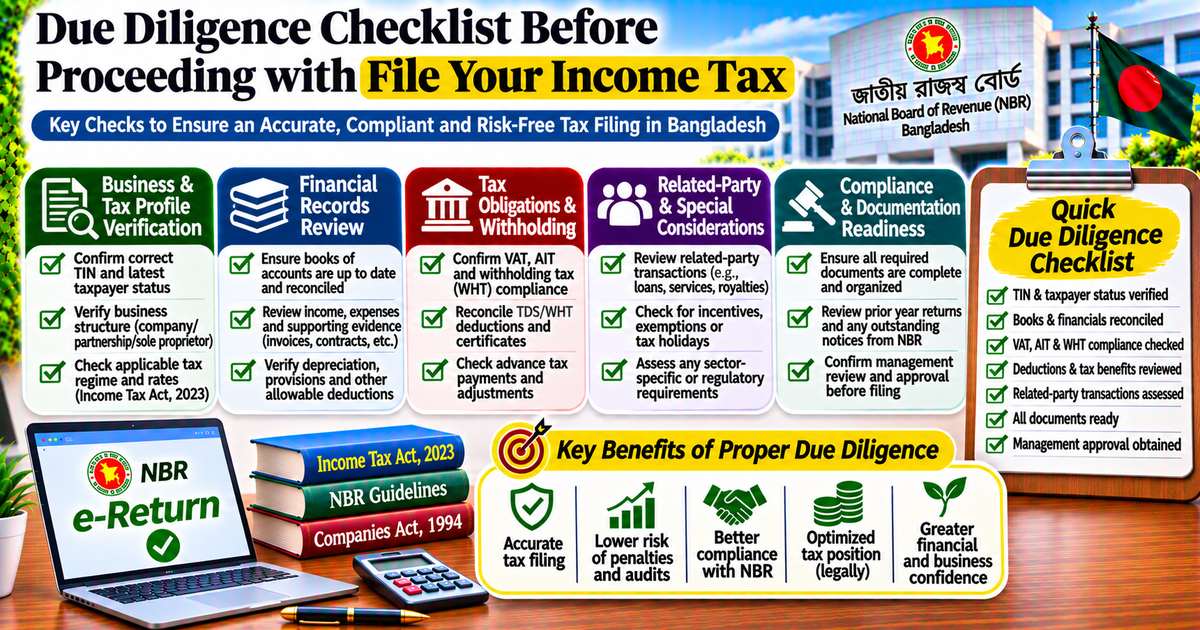
Due Diligence Checklist Before Proceeding with Your Company's Income Tax Return in Bangladesh
Introduction
Filing a company's income tax return is a statutory compliance responsibility, but submitting the return should be the final stage of a properly documented review. Before filing, the company should confirm that its financial statements, tax computation, supporting documents and disclosures are accurate and consistent.
A weak pre-filing review can expose a business to unnecessary tax adjustments, disputes, penalties and audit complications. A structured due diligence process helps the company identify discrepancies before they become formal compliance issues.
This checklist is designed for companies operating in Bangladesh. The applicable requirements should be checked against the Income Tax Act, 2023, subsequent amendments, relevant rules and the NBR's guidance for the relevant assessment year.
1. Confirm the Company's Tax Identity and Filing Obligations
Start by confirming that the return is being prepared for the correct legal entity and assessment year.
Review the following:
Company's registered legal name and incorporation details.
e-TIN and tax jurisdiction information.
Relevant income year and assessment year.
Registered and business addresses.
Nature of business and principal activities.
Whether the company has commenced operations, remained inactive or ceased business.
Previous income tax returns and assessment records.
Any outstanding tax demands, notices or pending proceedings.
Whether the company has any special tax status, exemption, reduced-rate facility or incentive and whether the relevant conditions have been satisfied.
Key due diligence question: Does the company have a clear understanding of its filing obligation and the tax treatment applicable to its business for the relevant assessment year?
Do not assume that an inactive company automatically has no filing obligation. The company's legal status and applicable statutory requirements should be reviewed.
2. Reconcile the Financial Statements
The company's accounting records should be reconciled before calculating taxable income.
Review:
Audited financial statements, where applicable.
Trial balance and general ledger.
Statement of profit or loss.
Statement of financial position.
Cash flow statement.
Bank statements and bank reconciliations.
Accounts receivable and payable schedules.
Inventory records and stock valuation.
Fixed asset register and depreciation schedule.
Loan balances and interest expenses.
Related-party balances and transactions.
Compare the financial statements with the underlying accounting records. Investigate unusual balances, unexplained adjustments, suspense accounts, negative balances and significant movements from the previous year.
A difference between accounting profit and taxable income is not necessarily an error. However, every material tax adjustment should have a clear explanation and supporting calculation.
3. Verify Revenue and Income Recognition
Revenue should be reviewed to ensure that all relevant income has been recorded and classified correctly.
Check:
Sales invoices and sales registers.
Service income and consultancy fees.
Export revenue, where applicable.
Commission and agency income.
Interest and other financial income.
Rental income.
Capital gains and asset disposal proceeds.
Other income and non-operating receipts.
Credit notes, sales returns and discounts.
Advances received from customers.
Reconcile revenue with bank receipts, customer ledgers, VAT records and other available transaction records.
For businesses with multiple revenue streams, review whether each category has been treated appropriately under the applicable income tax provisions.
4. Review Business Expenses and Disallowable Items
Expenses should be genuine, business-related, properly recorded and supported by adequate evidence.
Review the following categories:
| Expense category | Due diligence review |
|---|---|
| Salaries and benefits | Payroll, employee records and applicable withholding compliance |
| Rent | Agreement, payment evidence and applicable tax deduction |
| Marketing and advertising | Invoices, business purpose and payment records |
| Professional fees | Engagement documents, invoices and withholding tax |
| Travelling expenses | Travel records, bills and business justification |
| Interest expenses | Loan agreements, bank records and applicable tax restrictions |
| Repairs and maintenance | Nature of work and supporting invoices |
| Depreciation | Fixed asset register and tax depreciation treatment |
| Donations and contributions | Legal eligibility and supporting evidence |
| Entertainment and other expenses | Business purpose and applicable limitations |
Particular attention should be given to:
Personal expenses recorded as business expenses.
Unsupported or duplicate invoices.
Provisions and estimated liabilities.
Expenses relating to capital assets incorrectly treated as revenue expenses.
Payments that may trigger tax deduction at source obligations.
Expenses that are restricted or disallowed under the applicable tax law.
A payment appearing in the accounting ledger does not automatically mean that it is deductible for income tax purposes.
5. Examine Tax Deducted at Source (TDS)
Withholding tax compliance is an important part of corporate tax due diligence.
Review transactions that may require deduction or collection of tax at source, including:
Supplier and contractor payments.
Rent payments.
Professional and consultancy fees.
Salary and employment-related payments.
Commission and service payments.
Interest and other specified payments.
Payments to non-residents.
Import-related transactions, where applicable.
For each relevant transaction, verify:
Whether deduction or collection was legally required.
Whether the correct applicable rate and calculation basis were used.
Whether the tax was deducted or collected at the correct time.
Whether the amount was deposited within the prescribed period.
Whether the required certificates, statements and records are available.
Whether the company's books correctly reflect the tax deducted or collected.
Reconcile the withholding tax ledger with treasury challans, payment records, certificates and relevant statements.
Do not apply one standard withholding rate to every supplier or service provider. The applicable rate can depend on the nature of the payment, recipient, transaction and relevant statutory provisions.
6. Verify Advance Tax and Other Tax Payments
Before finalising the tax computation, identify all taxes already paid or credited to the company.
Check:
Advance income tax instalments.
Tax deducted at source.
Tax collected at source, where applicable.
Tax paid through treasury challans or approved electronic channels.
Previous-year adjustments or eligible tax credits.
Outstanding tax liabilities.
Interest, penalties or other amounts payable.
Ensure that each claimed credit is supported by appropriate evidence and can be reconciled with the company's tax records.
An incorrect or unsupported tax credit can result in a discrepancy between the return and the company's actual tax position.
7. Review Fixed Assets, Depreciation and Capital Transactions
Fixed asset transactions can have a significant effect on taxable income.
Review:
Opening written-down values.
New asset purchases.
Asset disposals and sale proceeds.
Assets transferred, scrapped or written off.
Capital work in progress.
Accounting depreciation.
Tax depreciation calculations.
Supporting purchase invoices and payment records.
Accounting depreciation and tax depreciation may differ. The company should prepare a separate tax computation where required rather than simply copying the depreciation figure from the financial statements.
8. Examine Loans, Liabilities and Related-Party Transactions
The company should confirm that its liabilities and financing arrangements are properly documented.
Review:
Bank loans and financing agreements.
Director and shareholder loans.
Intercompany balances.
Interest expense calculations.
Loan repayments and outstanding balances.
Related-party sales and purchases.
Management fees and service charges.
Transactions with non-resident associated enterprises.
Where transfer pricing provisions apply, assess whether the relevant documentation, disclosures and reporting requirements have been satisfied.
Unexplained related-party balances or unsupported interest expenses can create questions during an assessment or audit.
9. Check Tax Exemptions, Incentives and Special Treatment
If the company claims a tax exemption, reduced rate or incentive, verify its legal basis and eligibility.
The review should cover:
Relevant statutory provision or SRO.
Applicable business activity and sector.
Validity period of the incentive.
Required approvals, registrations or certificates.
Conditions attached to the tax benefit.
Separate accounting or reporting requirements, where applicable.
Compliance with conditions relating to banking transactions or other prescribed requirements.
An incentive should not be claimed solely because the company operates in a particular industry. Eligibility must be established under the relevant legal instrument and for the relevant period.
10. Reconcile Income Tax with VAT and Other Regulatory Records
Income tax, VAT and company-law compliance are separate obligations, but their records may be compared during a tax review.
Check whether the following records are consistent:
Annual sales in financial statements.
VAT returns and relevant VAT records.
Purchase and expense records.
Withholding tax records.
Bank transactions.
Payroll records.
Import and export documentation.
RJSC-related corporate records, where relevant.
Differences may arise for legitimate reasons, such as timing, accounting treatment or differences in tax bases. The company should document and explain material differences rather than attempting to force every figure to match.
11. Review Previous Returns, Assessments and NBR Correspondence
A company's historical tax position can affect its current filing.
Examine:
Previous income tax returns.
Tax computation schedules.
Assessment orders.
Audit notices and correspondence.
Tax demands and payment records.
Pending appeals or disputes.
Unresolved tax adjustments.
Previously claimed losses or other tax attributes, where legally available.
Check whether the company has carried forward any amount or tax treatment that requires verification under the current law.
If an earlier return contains an error, do not simply repeat it. Assess the legally available correction or revision mechanism and its applicable conditions before taking action.
12. Confirm Return Preparation, Approval and Authorisation
Before submission, complete a final review of the return and supporting schedules.
The responsible officers should verify:
Correct taxpayer identification.
Correct assessment year.
Accurate income classification.
Reconciled accounting profit and taxable income.
Correct tax rate and applicable tax treatment.
Accurate tax credits and payments.
Complete disclosures and required schedules.
Consistency with the approved financial statements.
Proper authorisation and verification by the legally responsible person.
The company should retain a copy of the final return, computation, supporting schedules and submission evidence.
13. Final Corporate Income Tax Due Diligence Checklist
Use the following checklist before authorising submission:
| No. | Review area | Completion |
|---|---|---|
| 1 | Company identity and e-TIN verified | ☐ |
| 2 | Assessment year and filing obligation confirmed | ☐ |
| 3 | Financial statements and trial balance reconciled | ☐ |
| 4 | Revenue and other income reviewed | ☐ |
| 5 | Business expenses and disallowable items examined | ☐ |
| 6 | TDS obligations and deposits reconciled | ☐ |
| 7 | Advance tax and other tax credits verified | ☐ |
| 8 | Fixed assets and tax depreciation reviewed | ☐ |
| 9 | Loans and related-party transactions examined | ☐ |
| 10 | Exemptions and incentives legally verified | ☐ |
| 11 | VAT and other records reconciled | ☐ |
| 12 | Previous assessments and NBR notices reviewed | ☐ |
| 13 | Tax computation independently checked | ☐ |
| 14 | Return reviewed and authorised | ☐ |
| 15 | Supporting records and filing evidence retained | ☐ |
14. What Should a Company Do if It Finds a Discrepancy?
A company should not rush to submit a return when material inconsistencies remain unresolved.
Instead:
Identify the discrepancy and the affected accounting or tax period.
Trace the issue to its original transaction or supporting record.
Determine whether it is an accounting error, tax adjustment, missing document or compliance failure.
Calculate the potential tax impact.
Review the applicable statutory correction mechanism.
Obtain appropriate professional advice for material or disputed matters.
Document the decision and retain the evidence.
The company should not alter accounting records merely to make the tax return appear consistent. Corrections should reflect genuine transactions and be supported by an appropriate audit trail.
Conclusion
Due diligence before filing a company's income tax return is a critical part of responsible corporate governance. It helps management confirm that the company's tax position is accurate, supported by evidence and consistent with the applicable law.
A well-prepared return begins with reliable accounting records, proper withholding tax compliance, verified tax payments and a documented review of potential risks. Companies should complete these checks before authorising submission—not after receiving an NBR query or assessment notice.
The Justice Corner assists businesses with corporate tax compliance, tax risk reviews, regulatory interpretation and legal support. A structured pre-filing review can help management identify issues early and make informed compliance decisions.
Legal disclaimer: This article provides general information on Bangladesh tax compliance and is not a substitute for advice based on a company's specific facts. The applicable law, amendments, rules, SROs and NBR guidance should be checked for the relevant assessment year before filing.