

Common Mistakes to Avoid When Filing an Income Tax Return in Bangladesh: Legal Risks and Compliance Guidelines
1. Introduction
Filing an income tax return is an important statutory responsibility for individuals, professionals and businesses in Bangladesh. Although the National Board of Revenue (NBR) has simplified the process through its electronic return submission system, taxpayers can still make mistakes that may result in financial liabilities, assessment complications or legal consequences.
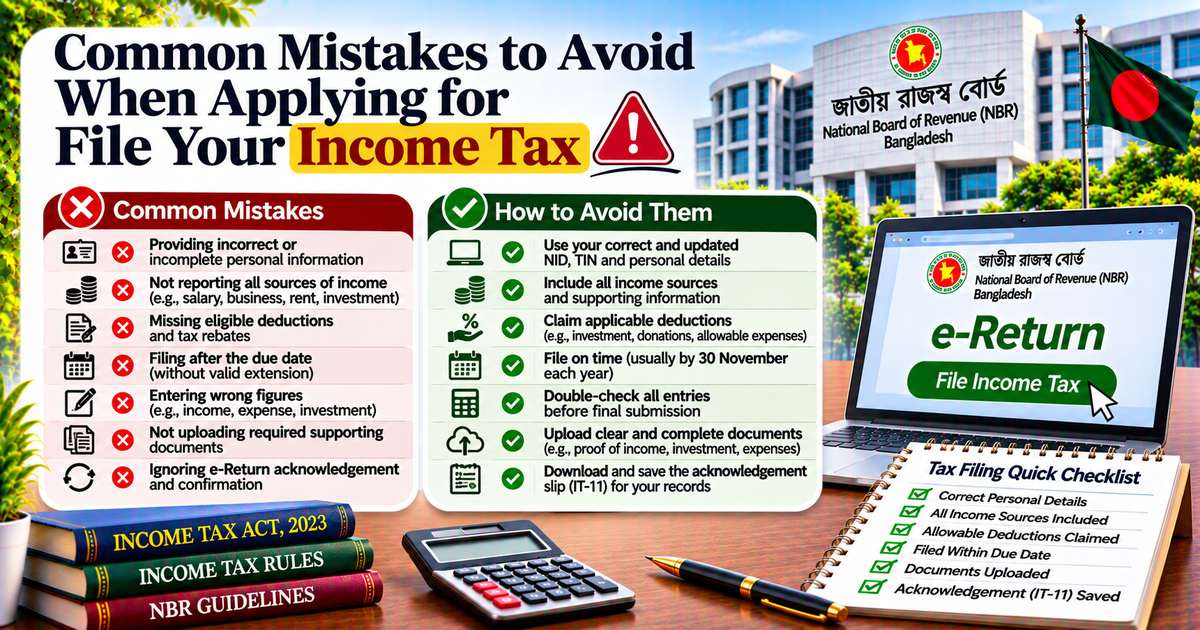
Common problems include underreporting income, incorrectly claiming investment tax rebates, failing to declare assets, overlooking tax deducted at source and submitting inconsistent financial information.
Importantly, submitting an income tax return electronically does not automatically establish that every declaration is accurate or legally compliant. Taxpayers remain responsible for the information provided in their returns.
This article examines the most common mistakes to avoid when filing an income tax return in Bangladesh, explains their potential legal implications and provides practical compliance recommendations.
2. Declaring Incorrect or Incomplete Income
One of the most significant tax filing mistakes is failing to disclose all applicable sources of income.
Taxpayers sometimes declare only their primary employment income while overlooking other income sources.
These may include:
Rental income.
Bank interest.
Business profits.
Professional and consultancy income.
Dividend income.
Capital gains.
Income from other taxable sources.
Under the Income Tax Act, 2023, taxable income must be determined and declared in accordance with the applicable provisions.
Example: An employee earns BDT 9 lakh annually and receives additional rental income of BDT 2 lakh. Declaring only the employment income without properly accounting for the rental income may result in an inaccurate return.
How to avoid it: Prepare a complete list of income sources and reconcile the figures with bank statements, employer certificates and other financial records.
3. Providing Incorrect Personal and TIN Information
Incorrect personal information can create registration, verification and administrative difficulties.
Common mistakes include:
Incorrect TIN numbers.
Name mismatches.
Incorrect NID information.
Outdated residential addresses.
Incorrect mobile numbers.
Selecting the wrong assessment year.
Taxpayers should review their personal details before completing the return.
For businesses, the company name, TIN and other registration information should remain consistent with the relevant corporate records.
4. Failing to Declare Assets and Liabilities Correctly
Asset and liability declarations are particularly important for taxpayers who own property, investments, vehicles or significant financial assets.
Common errors include:
Omitting land and apartment ownership.
Forgetting bank deposits.
Failing to declare savings certificates.
Incorrectly reporting share investments.
Ignoring outstanding loans.
Carrying forward assets that have already been sold.
Declaring inconsistent asset values.
For example, if a taxpayer declares a newly purchased apartment without properly accounting for the source of funds, the tax authority may seek an explanation regarding the acquisition.
How to avoid it: Maintain an annual asset register and reconcile changes in assets and liabilities with declared income, savings, loans and other legitimate sources of funds.
5. Claiming Investment Tax Rebates Without Proper Evidence
Investment-related tax benefits are subject to statutory conditions.
Some taxpayers incorrectly assume that every financial investment automatically qualifies for a tax rebate.
Eligible investments may include specified savings instruments, approved pension contributions, life insurance premiums and other investments recognised under applicable legislation.
Common mistakes include:
Claiming ineligible investments.
Declaring incorrect investment amounts.
Claiming investments without payment evidence.
Exceeding applicable statutory limits.
Claiming the same investment more than once.
How to avoid it: Review the applicable provisions of the Income Tax Act, 2023, and maintain certificates, receipts and statements supporting every claimed investment.
6. Ignoring Tax Deducted at Source (TDS)
Tax deducted at source is an important component of income tax compliance.
Employers, banks, financial institutions and other withholding entities may deduct tax before making certain payments.
Failing to account for eligible tax deductions can result in an incorrect calculation of outstanding tax.
For example, a salaried employee whose employer has already deducted income tax should verify that the relevant amount is properly reflected in the return.
How to avoid it:
Collect TDS certificates.
Review bank tax deduction statements.
Verify advance income tax payments.
Check the relevant information in the NBR e-Return Ledger.
Reconcile claimed tax credits with supporting records.
7. Confusing Tax-Free Income With Non-Reportable Income
Another common mistake is assuming that every tax-exempt income item can be ignored.
The legal treatment of income depends on the relevant exemption provisions and return disclosure requirements.
Certain exempt income may still need to be disclosed in the appropriate section of a return.
Taxpayers should distinguish between:
Taxable income.
Fully exempt income.
Partially exempt income.
Income subject to special tax treatment.
Income requiring disclosure under applicable instructions.
Incorrect classification can affect the accuracy of the return and the calculation of taxable income.
8. Making Errors in Business Income and Expenses
Businesses often face more complicated tax filing requirements than individual salaried taxpayers.
Common mistakes include:
Reporting incorrect sales figures.
Claiming unsupported business expenses.
Failing to reconcile bank transactions.
Incorrect depreciation calculations.
Misclassifying capital expenditure as revenue expenditure.
Omitting relevant income.
Maintaining inconsistent financial statements.
Companies should ensure that their income tax returns are consistent with their accounting records and applicable financial reporting requirements.
Where relevant, related-party transactions and withholding tax obligations should also be reviewed.
9. Filing Under the Wrong Assessment Year
Taxpayers sometimes confuse the income year with the assessment year.
The income year generally refers to the period during which income is earned, while the assessment year is the period for which that income is assessed.
Selecting an incorrect assessment year can result in inaccurate reporting.
How to avoid it: Check the applicable assessment year displayed in the NBR e-Return system before entering financial information.
10. Missing the Applicable Tax Return Deadline
Late submission is another common compliance mistake.
Taxpayers who postpone their filing until the final days may encounter technical problems, missing documents or payment delays.
Under the Income Tax Act, 2023, as amended, late filing can have financial and legal consequences depending on the circumstances.
These may include:
Additional tax.
Interest.
Statutory penalties.
Other consequences under applicable provisions.
Taxpayers should verify the current Tax Day through official NBR notifications rather than relying on previous years' deadlines.
11. Submitting a Return Without Reviewing the Final Information
The availability of online filing does not remove the taxpayer's responsibility to check the information submitted.
Some taxpayers enter figures incorrectly and immediately submit their returns without reviewing the completed declaration.
Before final submission, verify:
Personal information.
Income sources.
Taxable income.
Investment rebate claims.
Asset and liability information.
Tax deducted at source.
Advance tax payments.
Outstanding tax liability.
A final review can prevent avoidable errors.
12. Assuming That Online Submission Means the Return Cannot Be Examined
Successful electronic submission and permanent acceptance of every declaration are different matters.
The NBR may exercise its statutory powers of verification, audit, assessment and other lawful proceedings.
Under the Income Tax Act, 2023, taxpayers remain responsible for the accuracy of their declarations.
Therefore, supporting documents should be retained even when the e-Return system does not require them to be uploaded during submission.
13. Failing to Preserve Supporting Documents
Another common mistake is deleting financial records after submitting a return.
Relevant documents may include:
Salary certificates.
Bank statements.
Tax payment receipts.
TDS certificates.
Investment documents.
Property ownership records.
Business financial statements.
Previous tax returns.
These records may become important if NBR requests additional information or initiates verification.
Taxpayers should follow applicable statutory record-retention requirements.
14. Common Mistakes Made by Companies and Business Owners
Corporate taxpayers should pay particular attention to the following issues:
| Common mistake | Potential consequence |
|---|---|
| Incorrect financial statements | Inconsistent tax declarations |
| Unreported business income | Additional tax and assessment risk |
| Unsupported expenses | Disallowance of claimed expenses |
| Incorrect depreciation | Tax calculation discrepancies |
| Missing TDS information | Incorrect tax credit claims |
| Failure to reconcile bank accounts | Unexplained financial differences |
| Ignoring filing obligations | Statutory compliance consequences |
| Inconsistent director information | Corporate and tax verification issues |
Companies should coordinate their accounting, tax preparation and corporate compliance processes.
15. What Should You Do If You Discover a Mistake After Filing?
Discovering an error after submission does not mean that it should be ignored.
The appropriate corrective procedure depends on the nature of the error and the applicable statutory provisions.
Taxpayers should:
Identify the incorrect information.
Collect the relevant supporting documents.
Determine whether the error affects taxable income or tax payable.
Review the applicable revised-return provisions.
Check statutory deadlines and eligibility conditions.
Seek professional assistance where necessary.
A revised return should not be assumed to be available in every situation. Taxpayers must follow the applicable legal procedure.
16. Frequently Asked Questions (FAQs)
Q1. What is the most common mistake when filing an income tax return in Bangladesh?
Common mistakes include incomplete income declarations, incorrect asset information, unsupported investment rebate claims and failure to account for tax deducted at source.
Q2. Can I correct my income tax return after submission?
A correction may be possible through the applicable revised-return procedure, subject to statutory conditions and time limits.
Q3. What happens if I forget to declare bank interest?
Omitting taxable income can result in an inaccurate return and may create additional tax or assessment consequences depending on the circumstances.
Q4. Do I need to upload supporting documents during e-Return submission?
Generally, individual taxpayers do not need to upload supporting documents during online submission. However, they must retain relevant records and provide them if required by NBR.
Q5. Can a company file an income tax return showing a loss?
Yes. A company may submit a return showing a business loss. The company's statutory filing obligation does not automatically disappear because it has no taxable profit.
Q6. What happens if I miss the tax return deadline?
Late filing may result in additional tax, interest or penalties under the applicable provisions of the Income Tax Act, 2023, as amended.
Q7. Can I claim a tax rebate without investment documents?
Taxpayers should maintain supporting evidence for eligible investments. Unsupported claims may be challenged by the tax authority.
Q8. Where can I find official income tax filing instructions?
Visit the NBR official website at https://nbr.gov.bd/ or use its e-Return portal at https://etaxnbr.gov.bd/.
17. Conclusion
Avoiding common income tax filing mistakes is essential for maintaining financial transparency and legal compliance in Bangladesh.
Whether you are an individual taxpayer, company director, professional or business owner, accurate income declarations and proper financial documentation can reduce the risk of unnecessary tax disputes.
The most effective approach is to maintain organised financial records, verify tax payments, review asset declarations and ensure that every return complies with the applicable provisions of the Income Tax Act, 2023.
For complicated tax matters, corporate compliance concerns or disputes involving tax authorities, obtaining appropriate professional guidance can help protect your legal and financial interests.
Disclaimer: This article is intended for general legal and educational purposes. It does not constitute individual tax advice. Taxpayers should consult the latest legislation, Finance Acts, NBR notifications and relevant professional advisers before taking action.