

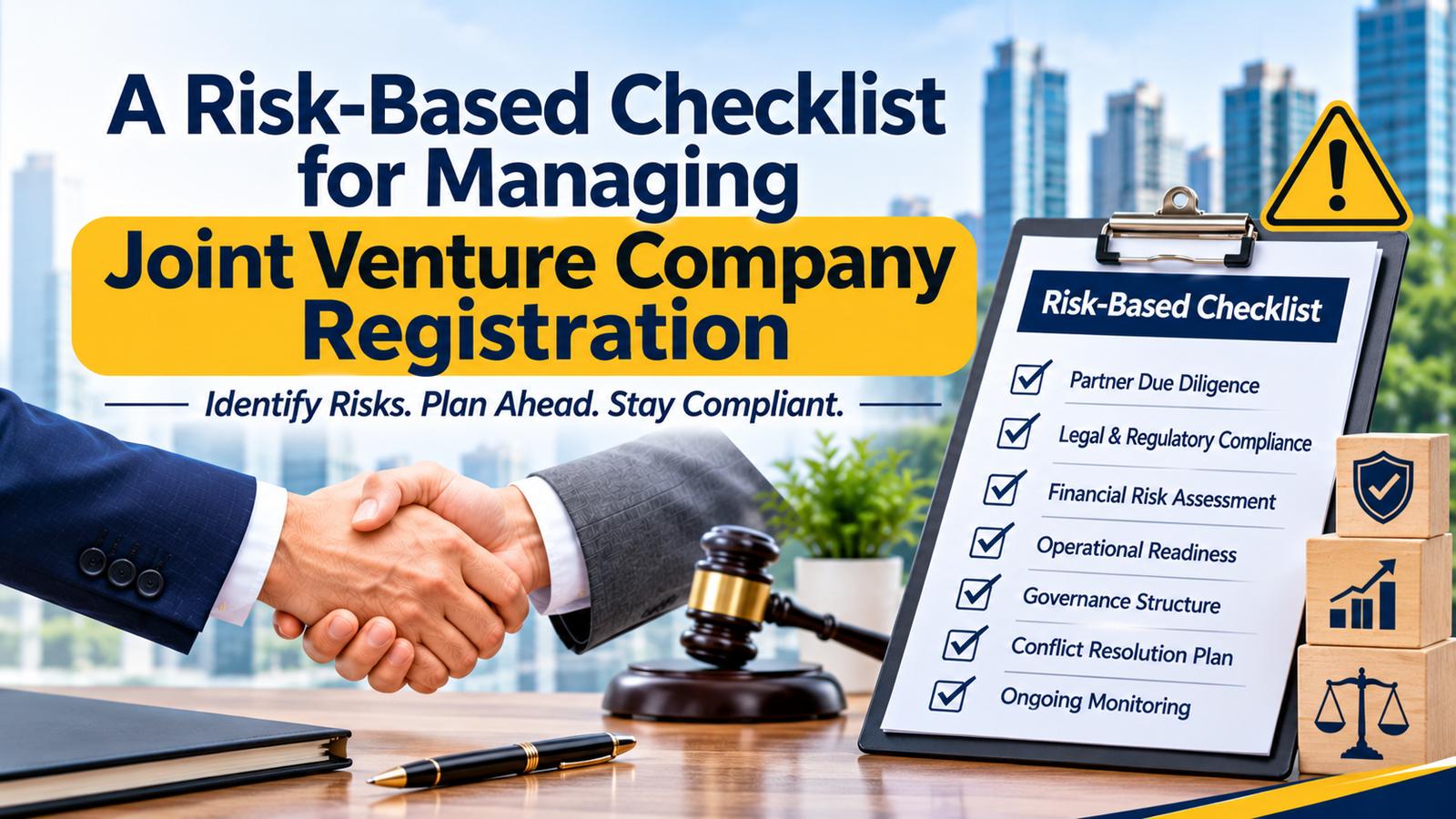
A Risk-Based Checklist for Managing Joint Venture Company Registration in Bangladesh
A joint venture (JV) can create valuable opportunities for businesses to combine capital, expertise, technology and market access. However, when two or more parties establish a joint venture company, they also bring together different commercial interests, management expectations and legal responsibilities.
Many JV-related disputes do not arise because the parties failed to register the company. They arise because important matters were not properly reviewed before incorporation: ownership percentages, decision-making authority, financial commitments, intellectual property rights, liability allocation and exit arrangements.
A risk-based approach helps investors identify these issues early, prioritise the most significant risks and build appropriate safeguards into the registration and governance process.
This article provides a practical checklist for managing joint venture company registration in Bangladesh, covering the key legal, financial, operational and regulatory considerations.
1. Understand the Proposed Joint Venture Structure
Before preparing incorporation documents, the parties should establish what type of joint venture they intend to create.
A joint venture may operate through a newly incorporated company, a contractual arrangement or another legally appropriate structure. The correct option depends on the parties' commercial objectives, investment arrangements, activities and regulatory obligations.
For businesses planning to establish a separate company in Bangladesh, a private limited company may be an appropriate structure, depending on the proposed ownership and business model.
The Registrar of Joint Stock Companies and Firms (RJSC) is the authority responsible for company incorporation and maintaining ownership-related records under the applicable laws.
EBRS
Risk assessment checklist
Confirm whether the parties intend to establish a new legal entity.
Identify the proposed legal form of the joint venture.
Define the commercial purpose and intended activities.
Confirm whether the business will operate locally, internationally or across borders.
Determine whether any sector-specific approval or licence may be required.
Assess whether the proposed structure supports the parties' long-term objectives.
Key risk: Selecting a structure without considering the actual business activities may create unnecessary compliance obligations or difficulties when obtaining regulatory approvals.
2. Conduct Due Diligence on Every Joint Venture Partner
A joint venture depends heavily on the reliability and capacity of its participants. Before agreeing to ownership arrangements, each party should understand the legal standing, financial position and business background of the other participants.
This is particularly important where one partner contributes capital while another contributes technology, intellectual property, operational expertise or access to an established market.
Due diligence should be proportionate to the size, complexity and risk profile of the proposed investment.
Risk assessment checklist
Verify the legal identity and registration status of each corporate partner.
Review the constitutional documents of corporate investors.
Identify the individuals authorised to negotiate and sign agreements.
Review relevant financial statements and available financial information.
Examine existing material contractual obligations.
Identify ongoing litigation, regulatory investigations or material disputes.
Review the ownership structure and identify relevant beneficial ownership concerns.
Assess whether each partner has the financial and operational capacity to fulfil its commitments.
Verify the ownership and authority to contribute any proposed intellectual property or technology.
Key risk: A partner may promise financial resources, technology or business relationships that it does not legally own or cannot deliver. Verification should take place before the parties make binding commitments.
3. Establish a Clear Ownership and Capital Contribution Framework
Ownership arrangements are among the most important elements of a joint venture. The parties should not rely on informal understandings when deciding how much each participant will invest and what rights they will receive.
A shareholder's contribution may involve cash, approved non-cash assets or other agreed arrangements, subject to applicable legal requirements.
The parties should distinguish between share capital, shareholder loans, future funding commitments and operational contributions.
For example, a joint venture may involve:
| Partner | Proposed contribution | Main consideration |
|---|---|---|
| Partner A | Financial investment | Payment schedule and funding obligations |
| Partner B | Technology and technical expertise | Ownership, valuation and licensing rights |
| Partner C | Market access and distribution support | Performance expectations and contractual obligations |
The value and legal treatment of non-cash contributions should be properly assessed rather than automatically treated as paid-up share capital.
Risk assessment checklist
Agree on the proposed shareholding percentages.
Determine the authorised and paid-up capital structure.
Document each shareholder's financial commitment.
Establish payment deadlines and funding procedures.
Identify whether any shareholder loans will be provided.
Assess how non-cash contributions will be valued and documented.
Define the consequences of delayed or incomplete contributions.
Establish procedures for additional capital requirements.
Review the legal and tax implications of the proposed arrangements.
Key risk: Unclear funding commitments can create disputes when the company requires additional capital or one shareholder fails to meet its agreed obligations.
4. Prepare a Comprehensive Joint Venture Agreement
A joint venture agreement is a central document for managing the commercial relationship between the participants.
Although the company's Memorandum of Association (MoA) and Articles of Association (AoA) establish its constitutional framework, the shareholders may need a separate agreement to address their detailed commercial rights and obligations.
The agreement should be prepared carefully and reviewed alongside the proposed constitutional documents.
Risk assessment checklist
Identify all parties and their respective responsibilities.
Define the purpose, scope and duration of the joint venture.
Document shareholding and capital contribution arrangements.
Establish board composition and nomination rights.
Define management responsibilities and reporting obligations.
Specify matters requiring shareholder approval.
Establish dividend and profit distribution principles.
Address confidentiality and information-sharing obligations.
Include appropriate intellectual property provisions.
Establish dispute resolution procedures.
Define share transfer restrictions and exit arrangements.
Address the consequences of material contractual breaches.
A particularly important consideration is consistency between the joint venture agreement and the company's Articles of Association. Where the documents address the same subject differently, the parties may face uncertainty over their respective rights and the company's decision-making process.
The legal enforceability and appropriate implementation of each provision should be reviewed under applicable Bangladeshi law.
5. Identify Governance and Decision-Making Risks
A joint venture can experience operational difficulties when the shareholders have equal ownership but no clear mechanism for resolving disagreements.
For example, two shareholders may each hold 50% of the company's shares. If the parties disagree on a major investment, appointment of senior management or expansion strategy, the company may struggle to make decisions.
This is commonly known as a deadlock risk.
Risk assessment checklist
Determine the number of directors and their appointment procedures.
Define the responsibilities of the board of directors.
Establish the authority of the Managing Director or Chief Executive.
Identify reserved matters requiring special approval.
Establish shareholder meeting and voting procedures.
Define quorum requirements.
Establish procedures for resolving board-level disagreements.
Include an appropriate deadlock resolution mechanism.
Define reporting and accountability requirements.
Review conflicts of interest and related-party transaction procedures.
Reserved matters may include:
Issuing new shares or changing the capital structure.
Borrowing above an agreed financial threshold.
Selling significant company assets.
Entering into major contracts outside the approved business plan.
Changing the company's principal business activities.
Appointing or removing key management personnel.
Approving mergers, acquisitions or business restructuring.
The parties should establish decision-making arrangements that protect legitimate shareholder interests without unnecessarily restricting ordinary business operations.
6. Review Regulatory and Sector-Specific Requirements
Company incorporation does not automatically authorise every type of business activity.
Depending on the nature of the proposed venture, additional registrations, permissions, licences or regulatory approvals may be required.
For example, an industrial joint venture may have different requirements from a company established solely for commercial trading.
The official Invest Bangladesh portal identifies documents for industrial project registration, including the Certificate of Incorporation, MoA and AoA, updated Trade Licence, TIN certificate, land or rental documentation and other project-related information. For foreign and joint venture investment, an encashment certificate and relevant regulatory documents may also be required.
Invest Bangladesh
The portal also identifies additional requirements for controlled sectors, including a No Objection Certificate from the relevant ministry, directorate or department where applicable.
Risk assessment checklist
Identify the regulator responsible for the proposed business activity.
Determine whether industrial project registration is applicable.
Check whether the business falls within a controlled or regulated sector.
Identify any required sector-specific licence or approval.
Review environmental and workplace-related regulatory requirements.
Determine whether import or export registration is necessary.
Check whether additional approvals are required for foreign investment.
Identify any restrictions applicable to the proposed ownership or investment structure.
Not every joint venture requires the same regulatory approvals. The applicable requirements should be established based on the actual business activity and investment structure.
7. Assess Foreign Investment and Cross-Border Risks
Where a joint venture includes a foreign shareholder, the parties should review foreign investment procedures, banking arrangements and applicable foreign exchange regulations before finalising the investment structure.
Important issues may include the remittance of investment capital, documentation of inward investment, foreign shareholder rights, dividend payments and the potential repatriation of eligible proceeds.
Bangladesh Bank issued FEID Circular No. 02 on 20 November 2024 concerning business operations by Joint Ventures, Consortiums and Associations having foreign partners. The circular addresses matters including establishment, reporting, banking transactions and cross-border financial arrangements for the relevant JVCA entities, particularly those involved in implementing government development projects. Its scope should be checked carefully before applying it to a different type of private-sector joint venture.
BB
Risk assessment checklist
Verify the foreign investor's identity and corporate authority.
Confirm the proposed foreign and local ownership percentages.
Review applicable foreign investment restrictions.
Establish the appropriate banking and remittance arrangements.
Document inward investment and obtain relevant banking evidence.
Review the applicable reporting requirements.
Assess dividend and profit distribution arrangements.
Review applicable tax and withholding obligations.
Consider currency fluctuation and cross-border payment risks.
Obtain professional advice on repatriation and foreign exchange compliance.
Key risk: An investment structure may be commercially acceptable to the shareholders but still require additional regulatory or banking procedures before certain transactions can be completed.
8. Protect Intellectual Property and Confidential Business Information
Technology, software, trademarks, manufacturing processes, customer databases and commercial know-how can be significant contributions to a joint venture.
However, the parties should clarify whether these assets are being transferred to the new company, licensed for specific purposes or made available under a separate contractual arrangement.
Without clear documentation, disagreements may arise over ownership and permitted use.
Risk assessment checklist
Identify all intellectual property contributed by each partner.
Verify ownership and existing third-party rights.
Determine whether the company receives ownership or a licence.
Define the permitted scope and duration of use.
Establish rules for improvements and newly developed intellectual property.
Address trademark and brand ownership.
Include appropriate confidentiality obligations.
Establish access controls for commercially sensitive information.
Define what happens to intellectual property when a shareholder exits.
For example, if one partner provides proprietary software, the agreement should clarify whether the joint venture can use it only during the partnership or whether it receives broader rights.
9. Review Tax, Accounting and Financial Reporting Risks
Financial transparency is essential for maintaining trust between joint venture partners.
The parties should establish accounting procedures and reporting responsibilities before the company begins operating. These arrangements should cover both statutory compliance and internal shareholder reporting.
Risk assessment checklist
Obtain the necessary tax identification and registrations.
Assess applicable VAT and tax obligations.
Establish appropriate bookkeeping procedures.
Determine financial year-end and reporting arrangements.
Establish internal financial approval procedures.
Define bank account operating authority.
Establish expenditure and procurement controls.
Agree on the preparation and circulation of financial statements.
Determine the process for appointing auditors.
Establish procedures for reviewing related-party transactions.
Document dividend approval and distribution procedures.
The RJSC identifies statutory filing and reporting requirements for registered companies. Its official guidance includes annual return and financial statement filing information, which should be checked against the company's applicable legal obligations and current filing procedures.
EBRS
Key risk: Weak financial controls can lead to unauthorised expenditure, inaccurate reporting and disagreements over the company's financial performance.
10. Build an Exit and Dispute Resolution Framework
A joint venture agreement should address not only how the relationship begins but also how it may end.
A shareholder may eventually wish to sell its shares, withdraw from the business or restructure its investment. The other shareholders may also need protection if a partner fails to fulfil its obligations.
The absence of a clear exit mechanism can make a disagreement significantly more difficult to resolve.
Risk assessment checklist
Define permitted share transfer arrangements.
Consider rights of first refusal or other agreed pre-emption rights.
Establish a valuation mechanism for share transfers.
Define procedures for voluntary withdrawal.
Address material breach and default.
Establish procedures for resolving deadlocks.
Consider mediation or arbitration where appropriate.
Identify the governing law and dispute resolution forum.
Address business continuity during a dispute.
Define the treatment of confidential information and intellectual property following exit.
The parties should ensure that any share transfer or restructuring arrangement complies with applicable company law, the company's constitutional documents and relevant regulatory requirements.
11. Complete the Company Registration and Post-Incorporation Review
After the commercial and legal arrangements have been agreed, the parties can proceed with the applicable incorporation process.
For a private company, RJSC's published checklist identifies documents such as the MoA, AoA, Form I, Form VI, Form IX, Form X and Form XII, together with evidence of name clearance and applicable stamp and treasury documentation. The precise filing requirements should be verified through the current RJSC system before submission.
EBRS
However, obtaining a Certificate of Incorporation should not be treated as the final step.
Registration and post-registration checklist
Complete the name clearance process where applicable.
Finalise the MoA and AoA.
Verify shareholder and director information.
Complete the applicable RJSC forms.
Review the consistency of the incorporation documents and joint venture agreement.
Submit the incorporation application.
Obtain and verify the Certificate of Incorporation.
Obtain the company's relevant registration documents.
Complete applicable tax and VAT registrations.
Obtain the required Trade Licence.
Open and maintain the company's bank account.
Obtain sector-specific licences and approvals where required.
Establish statutory registers and corporate records.
Set up an annual compliance calendar.
Implement the agreed governance and financial control procedures.
12. A Practical Risk-Priority Matrix for Joint Venture Registration
Not every risk requires the same level of attention. A practical risk assessment should consider both the likelihood of a problem and the potential consequences for the company.
The following matrix can help investors prioritise their review.
| Risk category | Potential consequence | Priority |
|---|---|---|
| Unclear ownership structure | Shareholder disputes and ownership uncertainty | High |
| Inadequate due diligence | Financial, legal or reputational exposure | High |
| Inconsistent JV agreement and AoA | Governance and enforceability disputes | High |
| Missing regulatory approval | Delayed operations or regulatory consequences | High |
| Unclear funding obligations | Capital shortages and business disruption | High |
| Weak financial controls | Mismanagement and inaccurate reporting | High |
| Unprotected intellectual property | Loss or misuse of valuable business assets | Medium–High |
| Unclear exit arrangements | Difficulties resolving shareholder disputes | High |
| Incomplete compliance records | Filing problems and potential statutory consequences | Medium–High |
The priority assigned to each risk should be adjusted according to the specific transaction. For example, foreign exchange compliance may become a particularly significant risk in a cross-border joint venture, while intellectual property protection may be central to a technology-based partnership.
13. Common Mistakes to Avoid During Joint Venture Company Registration
Even commercially experienced investors can overlook important legal and operational considerations when establishing a joint venture.
Some common mistakes include:
1. Relying only on verbal agreements
Informal discussions are not a substitute for properly documented contractual arrangements. Important commitments should be recorded in appropriate legal documents.
2. Treating the shareholding percentage as the complete governance structure
Ownership percentages alone do not explain how the board will operate, which decisions require special approval or how disagreements will be resolved.
3. Using generic Articles of Association without reviewing the JV structure
Standard provisions may not adequately address the commercial relationship between joint venture partners.
4. Ignoring future capital requirements
A company may need additional funding for expansion, working capital or unexpected expenses. The parties should agree on how such requirements will be handled.
5. Overlooking regulatory requirements
RJSC incorporation does not automatically provide every operational licence or sector-specific permission.
6. Failing to plan for shareholder exit
A joint venture should have a practical mechanism for share transfers, withdrawal, default and dispute resolution.
7. Neglecting post-incorporation compliance
The company must maintain appropriate records and comply with its ongoing statutory and regulatory obligations.
Frequently Asked Questions
1. Is a joint venture agreement necessary for registering a joint venture company in Bangladesh?
A joint venture agreement is an important document for defining the commercial relationship between the participants. Its necessity and specific requirements depend on the structure and circumstances of the investment. Where a foreign or joint venture industrial project is registered with Invest Bangladesh, its published requirements should be reviewed to determine the applicable supporting documents.
2. Can two companies establish a joint venture company in Bangladesh?
Yes. Businesses may establish a company together, subject to applicable company law, investment rules and any sector-specific requirements. The parties should properly document their respective shareholding, contributions and governance arrangements.
3. Does a foreign investor need approval before investing in a Bangladeshi joint venture?
The applicable procedures depend on the investment structure, sector and nature of the proposed activities. Foreign investors should review the relevant investment, foreign exchange and regulatory requirements before transferring capital or commencing operations.
4. What documents are required for joint venture company incorporation?
The requirements depend on the type of company and the proposed structure. For a private company, RJSC's published requirements include the Memorandum and Articles of Association, applicable incorporation forms, name clearance evidence and relevant stamp and treasury documentation.
Additional documents may be required for foreign investment, industrial project registration or regulated activities.
5. What happens if joint venture partners disagree?
The consequences depend on the joint venture agreement, Articles of Association and applicable law. A properly drafted agreement should establish procedures for negotiation, escalation, mediation or arbitration where appropriate, and provide a mechanism for resolving deadlocks.
6. Can a joint venture shareholder sell its shares?
Share transfers are subject to the Companies Act, 1994, the company's Articles of Association, applicable contractual arrangements and other relevant legal requirements. The parties should establish clear transfer procedures before incorporation.
7. Why is legal due diligence important before registration?
Due diligence helps identify potential ownership disputes, financial weaknesses, existing contractual obligations, regulatory concerns and intellectual property issues before the parties commit to the investment. It can reduce avoidable disputes and support better commercial decision-making.
How The Justice Corner Can Assist With Joint Venture Company Registration
Establishing a joint venture requires more than preparing incorporation forms. Investors need a legal structure that reflects their commercial objectives while addressing ownership, governance, contractual and regulatory risks.
The Justice Corner provides corporate legal support to businesses and investors seeking to establish and manage business relationships in Bangladesh.
Depending on the requirements of the proposed transaction, legal assistance may include:
Reviewing the proposed joint venture structure.
Conducting legal due diligence on participating entities.
Drafting and reviewing joint venture agreements.
Preparing or reviewing Memorandum and Articles of Association.
Advising on shareholding and capital contribution arrangements.
Reviewing board governance and shareholder rights.
Assisting with RJSC incorporation and related documentation.
Advising on applicable foreign investment and regulatory requirements.
Reviewing commercial contracts and intellectual property arrangements.
Advising on corporate compliance and dispute prevention.
Early legal review can help the parties identify important risks before they become expensive operational or shareholder disputes.
For assistance with joint venture company registration, corporate structuring or shareholder agreements in Bangladesh, businesses may consult The Justice Corner for appropriate legal guidance.
Conclusion
Joint venture company registration should be approached as a structured risk-management process rather than a documentation exercise.
The most important safeguards begin before incorporation: verifying the participating partners, defining ownership and financial commitments, preparing a comprehensive joint venture agreement, establishing effective governance and identifying applicable regulatory requirements.
A well-planned registration process can provide a stronger foundation for transparency, accountability and long-term commercial cooperation.
Investors who identify and address potential risks early are better positioned to protect their interests and build a sustainable joint venture in Bangladesh.
Legal Disclaimer: This article is intended for general informational purposes only and does not constitute legal, tax or investment advice. The applicable requirements may vary depending on the proposed company structure, business activities, ownership arrangements and regulatory framework. Professional legal advice should be obtained before proceeding with a specific joint venture transaction.
References and Official Resources
Registrar of Joint Stock Companies and Firms (RJSC) – Official FAQs
Invest Bangladesh – Foreign and Joint Venture Projects
Invest Bangladesh – Frequently Asked Questions
Bangladesh Bank – FEID Circular No. 02, 20 November 2024